Dominant Logic in the Car Industry: Why Companies Hold On to Broken Assumptions

Why do carmakers cling to broken assumptions? Data on German car boards since 2012 shows how dominant logic lives in the people at the top.
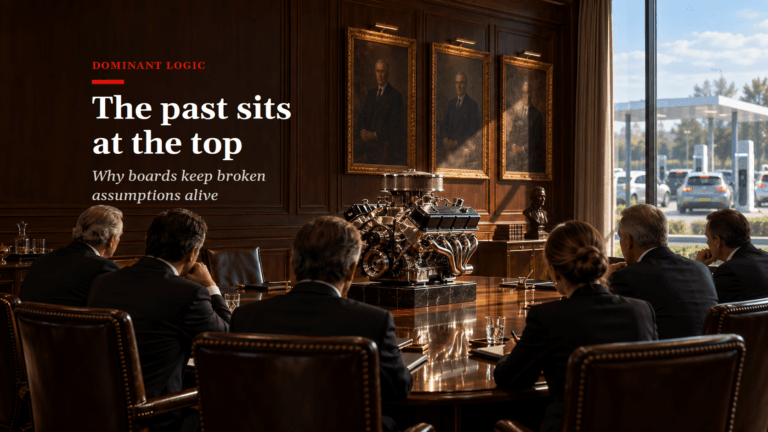
Why do carmakers cling to broken assumptions? Data on German car boards since 2012 shows how dominant logic lives in the people at the top.

Lately, I have spent far too much time thinking about meaningless corporate work: intelligent people producing perfect presentations, precise numbers and carefully aligned decisions—without anybody asking whether the work is relevant at all. Then AI arrived. It might liberate us from meaningless work. Or it might help us produce more of it, faster and with unprecedented precision. The idea for…

There is a debate raging across Germany and much of Europe about how cars should be powered in the future. Battery-electric. Hydrogen. eFuels. HVO100. The framing is almost always the same: which technology is best? Which one is cleanest, most convenient, most German? The word you hear most often is Technologieoffenheit – technology-openness, the noble-sounding demand that we keep all…

This post argues that sustaining innovation — accelerators, innovation labs, venture clienting, e-fuels, hydrogen engines — is not dangerous because it fails, but because it works. Working results are the reason nobody has to ask whether the business model still holds. The argument runs through four cases: the record labels and DRM, thirty-five years of German automotive from the 1991…

In 2022, the quick-commerce business model looked unstoppable. Gorillas had turned “groceries in ten minutes” into a cultural signal and a venture-capital magnet. Its Turkish rival Getir was valued at twelve billion dollars. Four years later Getir sold what was left of its delivery business to Uber for $335 million – a ninety-seven-percent collapse. Along the way it had already…

For more than a million readers, this blog has been about one theme: business model innovation. Not as a buzzword, but as a discipline with two faces – the business model as an instrument of analysis, a way to understand precisely how a company creates, delivers, and captures value; and the business model as an instrument of imagination, a way…
End of content
End of content