
Anthropic’s Business Model: Can It Become the Dominant AI Business Model?

Anthropic calls the enterprise adoption of Claude the fastest of any technology in history, and by one estimate it led enterprise spending on AI model APIs in 2025. The business model behind that growth is now documented in its S-1 and the amendment of November 2, 2026. This second post on Anthropic asks whether that business model can become the dominant AI business model, and how it could be defended. It looks at three effects: economies of scale, which are strong; network effects, which are contested; and a third effect I call economies of self-improvement. It then separates the effect from its defence and sets out the options that could make Anthropic’s business model defensible, and the paths Google, OpenAI and the open-weight AI models have chosen. The industry is still in its fluid phase, so the post shows patterns and passes no verdict. It ends with lessons for any industry in which the core product can be copied.
Can Anthropic’s business model become the dominant AI business model?
Anthropic describes the enterprise adoption of Claude as the fastest of any technology in history (S-1/A, p. 6). Its revenue went from 41 million dollars in 2023 to 4.6 billion in 2025 and 17.0 billion in the third quarter of 2026 alone (S-1/A, p. 24 and p. 161). In the second quarter of 2026, it reported an operating profit of 974 million dollars, the first in the quarters it discloses; in the third quarter, it was back to an operating loss of 567 million (S-1/A, p. 161). According to Menlo Ventures, Anthropic’s share of enterprise spending on large language model APIs rose from 12 per cent in 2023 to 40 per cent in 2025, ahead of OpenAI and Google (Menlo Ventures, 2025).
In the first post on Anthropic’s business model, I described its four elements as the S-1 presents them. This post asks the next question. Growth and market share show that Anthropic’s value proposition works today. What they do not show is whether Anthropic’s business model can become the dominant AI business model, and whether it can be defended once it is.
One company shows what is at stake. Google was not the first search engine, and it did not own every idea it built on. In 2002, Overture, later a Yahoo subsidiary, sued Google for infringing its U.S. Patent No. 6,269,361. In August 2004, Google settled that suit together with a dispute over a Yahoo warrant, issued 2.7 million shares to Yahoo and received a perpetual licence to the patent (Google 10-Q, Q3 2004, note 4). Google was the first to find the dominant business model of search and to make it defensible, later also through paid default placements on browsers and phones. A U.S. federal court ruled in August 2024 that Google had unlawfully maintained its search monopoly, in part through exclusive distribution agreements that made Google the preloaded default search engine (Memorandum Opinion, August 5, 2024; summary by Simpson Thacher). In the fourth quarter of 2025, Google Services earned an operating income of 40.1 billion dollars, while Other Bets lost 3.6 billion (Alphabet earnings release Q4 2025). One dominant business model pays for every other experiment, as I showed in the post on Google’s cash flow.
Whether AI will produce returns like these is more than doubtful. The rest of this post explains why, with Anthropic as the case.
The AI business model is still fluid, but closer to the next phase than it looks
In 1975, James Utterback and William Abernathy described how innovation in an industry moves through phases (Utterback & Abernathy, 1975). Utterback later set out the fluid, transitional and specific phases and the role of the dominant design in Mastering the Dynamics of Innovation (1994). In the fluid phase, many firms experiment and product innovation dominates. In the transitional phase, a dominant design emerges, the number of firms falls and process innovation gains weight. In the specific phase, cost and efficiency decide.
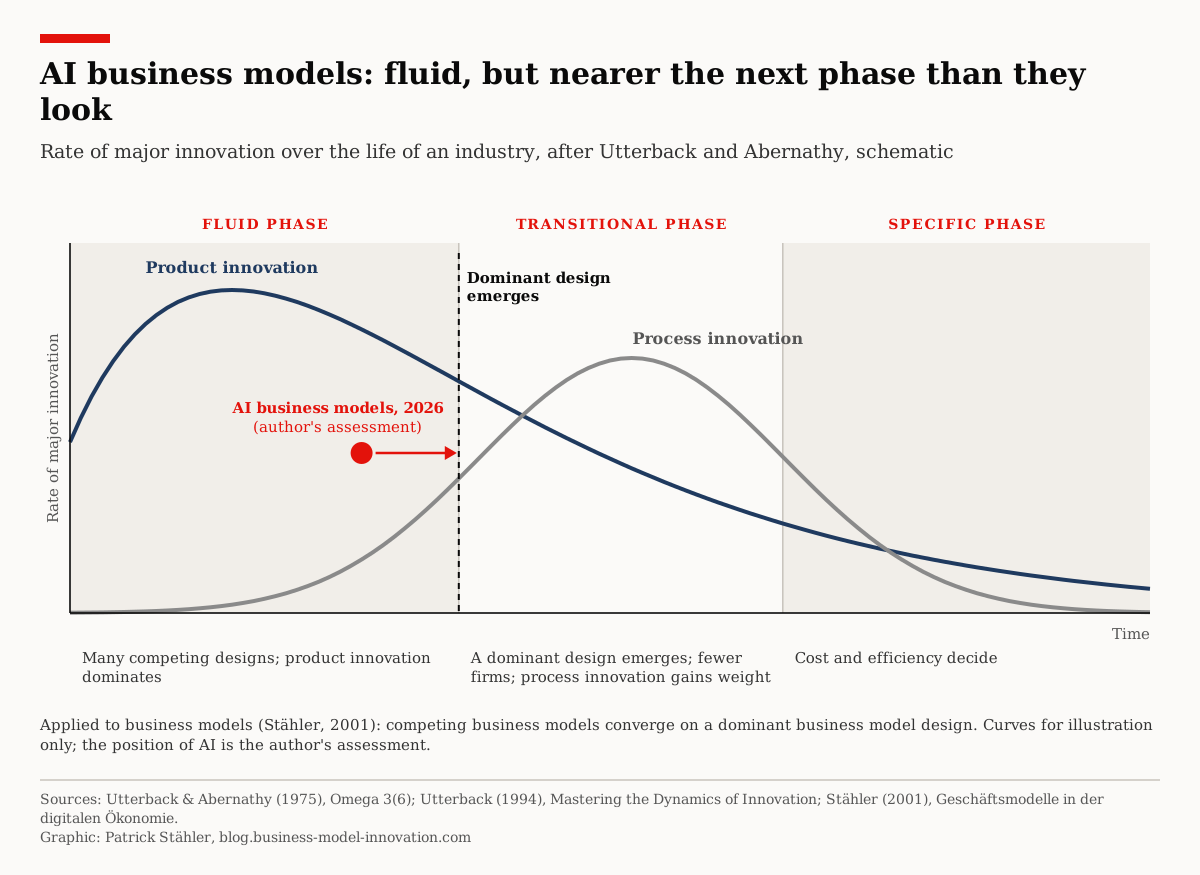
They described the dominant design of a product. In my 2001 dissertation, I applied the idea to business models: the dominant business model design (see also Where Business Model Innovation Really Came From and Powertrain Business Model).
Where does AI stand? The signs still point to the fluid phase. Anthropic launched 250 new AI model versions, platform features and applications in nine months (S-1/A, p. 144). AI model versions released in the previous six months brought in more than 80 per cent of its third-quarter revenue (S-1/A, p. 145). Product innovation of this speed is the mark of a fluid industry.
Other signs point to the transitional phase. Among the labs that develop frontier AI models, Anthropic names Google and OpenAI as its primary competitors (S-1/A, p. 42). According to Menlo Ventures, these three providers accounted for 88 per cent of enterprise usage of large language model APIs in 2025 (Menlo Ventures, 2025). The players still experiment, but they are far ahead of where they stood in November 2022, when ChatGPT was released.
A caution belongs here. The small number of frontier labs may reflect the capital needed to train frontier AI models more than a dominant design. In the application layer, many providers still compete. The AI business model is fluid, but the circle of players who can still shape its dominant design has become small.
Anthropic’s economies of scale are strong, but compute can still swallow them
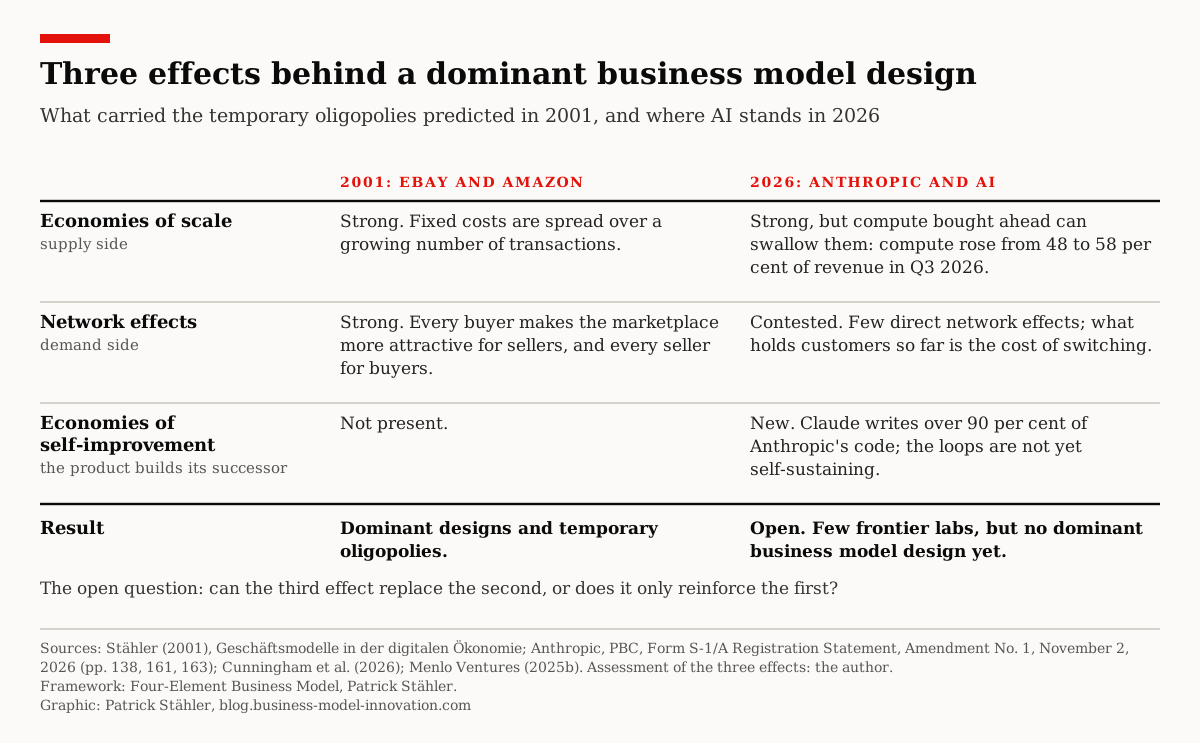
Two drivers typically carry a dominant business model design: economies of scale on the supply side and network effects on the demand side. In AI, the first is strong.
Each generation of AI models is a large fixed cost. In the first nine months of 2026, Anthropic spent 19.2 billion dollars on research and development and 4.8 billion on serving its paying customers (S-1/A, p. F-40). The more customers use an AI model, the more widely that fixed cost is spread. Compute and infrastructure costs fell from 251 per cent of revenue in the first quarter of 2025 to 48 per cent in the second quarter of 2026 (S-1/A, p. 162). Anthropic attributes the fall to revenue growth that “outpaced the growth of our committed compute cost base” (S-1/A, p. 163). In the third quarter, the share rose again, to 58 per cent. The reason was additional compute, including “$5.0 billion of compute under short-term commitments, which currently costs significantly more than comparable compute procured under our multi-year commitments” (S-1/A, p. 163).
Scale lowers the cost of every AI model generation per customer, but only as long as revenue grows faster than the compute bought ahead of it. It also raises the price of entry for everyone who wants to train the next one.

Do network effects protect Anthropic? The evidence is contested
The demand-side driver is network effects. In AI, it is the weak point, and it deserves a closer look.
Direct network effects hardly exist. When I use Claude, Claude does not become more valuable for you. On eBay, every additional buyer made the marketplace more attractive for sellers, and every seller for buyers.
The candidate is the data network effect: an AI model improves as more customers use it, which attracts more customers. Robert Gregory and his co-authors give this mechanism a theoretical basis (Gregory et al., 2021). Anthropic claims a version of it. Its “Improvement Loop” improves AI models, platform and applications “based on feedback from customers using our offerings in production”, and the company believes these loops “create durable competitive advantages” (S-1/A, p. 11). Martin Casado and Peter Lauten were sceptical in The Empty Promise of Data Moats: “defensibility is not inherent to data itself”. As the data corpus grows, the moat erodes while competitors catch up.
The evidence on lock-in points both ways. In its risk factors, Anthropic itself states that “even minor degradations in model performance or increases in response latency could cause customers to reduce usage or switch to competitors” (S-1/A, p. 44). Market shares show how fast the field has moved. According to Menlo Ventures, OpenAI’s share of enterprise LLM API spending fell from 50 per cent in 2023 to 27 per cent in 2025, while Anthropic’s rose from 12 to 40 per cent (Menlo Ventures, 2025). Menlo Ventures is one of Anthropic’s investors (Bloomberg, 2024), and the figures are estimates. Shifting shares do not prove that individual customers switched; much of the change comes from new spending and new workloads. In a survey from mid-2025, Menlo Ventures found that only 11 per cent of builders had switched vendors, while 66 per cent had upgraded within their existing provider: “Once builders commit to a platform, they tend to stay” (Menlo Ventures, 2025b). Where customers stay, the reason so far is the effort of integration, a switching cost rather than a network effect.
A third route runs through standards. Anthropic introduced the Model Context Protocol in November 2024, a universal interface through which AI tools connect to enterprise data and systems, and handed it to the Linux Foundation’s Agentic AI Foundation in December 2025 (S-1/A, p. 205). Every new connector makes the ecosystem more useful. Because the standard is open, the effect benefits every AI model that speaks it.
In AI, the network effect that made earlier dominant designs stable has so far been weak; what holds customers is the cost of switching. This is the pattern so far. It may change once AI agents are deeply embedded in a customer’s organisation.

Economies of self-improvement: the third effect in Anthropic’s business model
There is a third effect that neither economies of scale nor network effects describe. I call it economies of self-improvement: the cost and speed advantages that arise when a product improves the production of its own next generation.
Anthropic describes it in its own words: “each new version of a Claude model directly accelerates development of the next”; the company calls this “closing the loop” (S-1/A, p. 12). Over 90 per cent of the contributions to its codebase in September 2026 were written by Claude (S-1/A, p. 138). In April 2026, the monthly value of Anthropic’s internal Claude usage at list prices exceeded its monthly personnel expense, excluding stock-based compensation, for the first time (S-1/A, p. 189).
The effect differs from the learning curve. There, the people who make a product learn (Wright, 1936). Here, the product works on its own production. In the AI safety literature, the point at which a system’s improvement comes mainly from its own contributions is called the “crossover” (Bostrom, 2014, ch. 4). Anthropic’s figures point in that direction. They do not prove that it has been reached.
The effect also has a brake. A group of economists around Tom Cunningham estimates, in a back-of-the-envelope calibration, that today’s loops of AI building AI are not yet self-sustaining, though they are getting stronger (Cunningham et al., 2026). Tom Davidson and co-authors show under which conditions automating AI research leads to accelerating growth and when it levels off (Davidson et al., 2026). I will treat the term in a separate post.
Economies of self-improvement could replace the missing network effect, or they could simply reinforce scale. If they replace it, AI has a new mechanism of defence. If they only reinforce scale, the winner is whoever has the most capital.
An effect is not a defence: where Anthropic’s business model leaks
All three effects are real. None of them is automatically a defence. An effect protects a business model only if it stays with the company that creates it.
The AI business model leaks in three places. Competitors, customers and others attempt to “replicate, distill, extract, or otherwise derive” the capabilities of Anthropic’s AI models (S-1/A, p. 42). Open-weight AI models could take parts of the market and put pressure on prices (S-1/A, p. 43). In the third quarter alone, price reductions with new model versions and contractual discounts cost Anthropic about 600 million dollars of revenue (S-1/A, p. 162). And if the ability to develop highly capable AI models becomes more broadly available, competition “could increasingly depend on access to large-scale compute rather than on model development capability” (S-1/A, p. 43).
The last point leads back to the architecture. Anthropic obtains most of its compute from cloud providers and other third parties, and its principal competitors rely on “substantially similar inputs” (S-1/A, p. 39). In my terms, compute is a borrowed block. Renting is normal and often sensible; an architect hires workers to build a house. It becomes a question of defence only when the uniqueness of the business model rests on the borrowed block. The third quarter showed what that means: short-term compute bought at a premium turned an operating profit into a loss. To secure capacity, Anthropic reports an “aggregate committed spend of approximately $895.4 billion, substantially all of which is related to compute and infrastructure”, about half of it expected before the end of 2030 (S-1/A, p. 7). The figure includes leases signed but not yet commenced (451.2 billion) and commitments made after September 30, 2026; the contractual obligations as of that date amount to 320.0 billion (S-1/A, pp. 174–175). Anthropic warns that “the basis of competition could shift over time to encompass not only which company can develop the most capable models, but also which company can develop the best underlying components”. Vertically integrated competitors could, through hardware-software co-design, “compound any capability gap across successive model versions” (S-1/A, p. 39).

Here the third effect and the architecture meet. If economies of self-improvement run on compute, then whoever controls compute controls the speed of the loop. In the economic model of Davidson and co-authors, automating tasks in hardware research has roughly ten times the effect of automating tasks in final-goods production (Davidson et al., 2026).
Options that could make Anthropic’s AI business model defensible
What would make an AI business model defensible? David Teece answered the general question in 1986. When an innovation is easy to imitate, the profits go to whoever owns the complementary assets, not necessarily to the innovator (Teece, 1986). For AI, the question becomes which complementary assets a lab can own. I set them out without recommending any of them. Each sits in one element of the Four-Element Business Model.
Forward integration into a harness and applications (value creation architecture: offer). Anthropic names the harness as one of the reasons Claude Code works: “a harness that translates intent into actions” (S-1/A, p. 9). Its strategy is to extend this with applications “purpose-built for specific professions and industry verticals” (S-1/A, p. 9). The risk, in my terms, is channel conflict. Top customers may “develop their own solutions that compete with our models, platform, and applications” (S-1/A, p. 59).
Industry solutions (offer and core capabilities). Anthropic offers Claude for Financial Services, Healthcare, Life Sciences, Legal, Education and Government, among others, each with “domain knowledge, data connectors, skills, and compliance controls pre-loaded” (S-1/A, p. 197). Domain knowledge is harder to copy than an AI model.
Deeper into the customer (value proposition). One obstacle to the diffusion of Claude is “the natural resistance to change within organizations” (S-1/A, p. 241). Anthropic’s value proposition is only redeemed if the customer changes its own organisation. I described this in the first post; I call it the redemption gap. The gap is an obstacle today. Once a customer has rebuilt its processes around Claude, the same gap becomes a cost of switching. This is my own interpretation.
Backward integration into compute (production). Anthropic co-designs its AI model architecture with its inference infrastructure (S-1/A, p. 192), and an increasing part of its investment goes into its own compute and infrastructure (S-1/A, p. 140). It is a move from renting the block towards owning it.
Own distribution (distribution). In the first nine months of 2026, about 44 per cent of revenue came through the cloud marketplaces of Amazon, Google and Microsoft, down from 48 per cent in the first half (S-1/A, p. F-17). Anthropic points to “changes in the terms of our channel partner distribution arrangements” (S-1/A, p. 163). Certain of these cloud providers are also investors, customers and competitors (S-1/A, p. 143). A larger direct channel would own more of the customer relationship.
Trust (corporate spirit). Safety and reliability are part of what customers buy from Anthropic. The values are easier to write than to live, as the first post showed, which is exactly why living them can become hard to copy.
Each of these options alone can be copied. A harness can be built by others, and Google has better chips. Defensibility comes from the combination of several own, interdependent building blocks. This is what I call the uniqueness of a business model, or UBM.

How Google, OpenAI and the open-weight AI models answer the same question
The competitors have chosen different paths. What follows describes them without ranking them.
Google is integrated backwards. It designs its own chips and runs its own cloud. Google Cloud now earns product revenue “primarily from the sale of TPU systems” (Alphabet 10-Q Q3 2026, segment note). Anthropic is among the labs that run on Google’s TPUs (S-1/A, p. 138). It also owns distribution through search, Android and its cloud. Menlo Ventures puts Google’s share of enterprise API spending at 21 per cent in 2025, up from 7 per cent in 2023.
OpenAI is integrating in both directions. Forward, it merged with io, the device start-up of the former Apple designer Jony Ive, in a deal worth 6.5 billion dollars (Bloomberg, 2025). Backward, it designs its own AI accelerators and deploys them with Broadcom: 10 gigawatts, starting in the second half of 2026 and completed by the end of 2029.
The open-weight AI models, from Meta’s Llama to DeepSeek, Qwen and Mistral, push in the opposite direction. They turn the AI model layer into a commodity. When DeepSeek published its reasoning AI model in January 2025, it showed how quickly a capability gap can close. In the enterprise, however, open-source AI models lost ground: their share fell from 19 per cent in 2024 to 11 per cent in 2025. Menlo Ventures attributes this partly to the stagnation of Meta’s Llama and reports that enterprises “remain cautious, preferring closed-source models”. A further reason, in my reading: companies pay for reliability, controls and support, and these come from the business model around the AI model.
Each lab is betting on a different combination, and none has yet shown that its combination cannot be copied.
Lessons learned for every industry in which the core product can be copied
1. Ask what makes a business model dominant, not which product is best. Google won search with its business model, years after the first search engines.
2. Separate the effect from its defence. Scale, networks and self-improvement create advantages. They protect only the company that can keep them.
3. Check whether your network effects are real. Customers who stay because switching is tedious give you a switching cost. That protects you only until a competitor makes switching easy.
4. Watch whether your product works on its own production. Economies of self-improvement are new in AI, but every company can ask how much of the next generation its current product already builds.
5. Know which of your building blocks are borrowed. Renting is fine. It becomes a risk when your uniqueness rests on the rented block, as one quarter of short-term compute showed.
6. Build defensibility from combinations: the uniqueness of your business model (UBM). A single advantage is copied; a system of own, interdependent building blocks is hard to copy.
7. In the fluid phase, act to learn. No outsider can know today which AI business model will win. The players learn by acting, and so should everyone who builds on them.
Understand. Imagine bigger. Act.
Annotated bibliography
- Alphabet Inc. (2026): Fourth quarter and fiscal year 2025 results. Segment operating income of Google Services, Google Cloud and Other Bets. Link
- Anthropic, PBC (2026): Form S-1/A Registration Statement, Amendment No. 1, November 2, 2026. Primary source for all Anthropic figures and quotations in this post; adds the third quarter of 2026 and the aggregate compute commitments to the original filing of October 26, 2026. Link
- Bostrom, N. (2014): Superintelligence: Paths, Dangers, Strategies, Oxford University Press. Cited only for the term “crossover” (ch. 4), the point at which a system’s further improvement comes mainly from its own contributions. Link
- Casado, M. & Lauten, P. (2019): “The Empty Promise of Data Moats”, a16z. Argues that defensibility is not inherent to data, because the advantage of more data erodes as the corpus grows and competitors catch up. Link
- Cunningham, T. et al. (2026): “The Economics of Recursive Self-Improvement”, arXiv 2609.15802. Finds that today’s loops of AI building AI are not yet self-sustaining, but strengthening. Link
- Davidson, T., Halperin, B., Houlden, T. & Korinek, A. (2026): “When Does Automating AI Research Produce Explosive Growth? Feedback Loops in Innovation Networks”, NBER Working Paper 35155. Sets out the conditions under which automating AI research accelerates growth. VoxEU column
- Gregory, R. W., Henfridsson, O., Kaganer, E. & Kyriakou, H. (2021): “The Role of Artificial Intelligence and Data Network Effects for Creating User Value”, Academy of Management Review 46(3), pp. 534–551. Gives the theoretical basis for data network effects in AI. Link
- Menlo Ventures (2025): “2025: The State of Generative AI in the Enterprise”. Estimates enterprise spending and market shares of AI model providers, including the shift from OpenAI to Anthropic and the share of open-source models. Menlo Ventures is one of Anthropic’s investors. Link
- Menlo Ventures (2025b): “2025 Mid-Year LLM Market Update”, July 31, 2025. Survey of builders; finds that few switch vendors once committed to a platform. Link
- Stähler, P. (2001): Geschäftsmodelle in der digitalen Ökonomie. Dissertation, University of St. Gallen. Extends the dominant design to business models and predicts temporary oligopolies carried by network effects and economies of scale. ResearchGate / Discussed here
- Teece, D. J. (1986): “Profiting from technological innovation: Implications for integration, collaboration, licensing and public policy”, Research Policy 15(6), pp. 285–305. Shows that when imitation is easy, profits go to the owners of complementary assets. Link
- Utterback, J. M. (1994): Mastering the Dynamics of Innovation, Harvard Business School Press. Sets out the fluid, transitional and specific phases of an industry and the emergence of a dominant design. Link
- Utterback, J. M. & Abernathy, W. J. (1975): “A dynamic model of process and product innovation”, Omega 3(6), pp. 639–656. Introduces a dynamic model in which innovation in an industry moves through phases, from product to process innovation. Link
- Wright, T. P. (1936): “Factors Affecting the Cost of Airplanes”, Journal of the Aeronautical Sciences 3(4), pp. 122–128. The origin of the learning curve. Link
