Same AI, Three Horizons: Why the Application Decides the Innovation

AI models are a great innovation. Using them rarely is. The three horizons show why the application, not the technology, decides the innovation.

AI models are a great innovation. Using them rarely is. The three horizons show why the application, not the technology, decides the innovation.
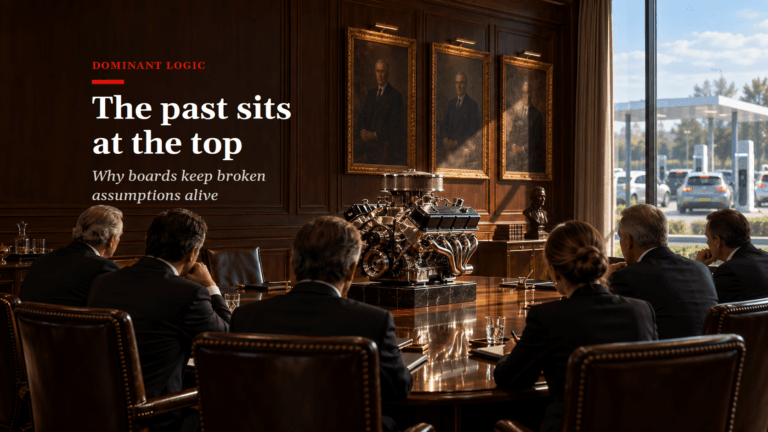
Why do carmakers cling to broken assumptions? Data on German car boards since 2012 shows how dominant logic lives in the people at the top.

Every business model rests on assumptions about the world it operates in. The trouble starts when those business model assumptions stop being recognisable as assumptions and quietly turn into certainties. This post begins with Drucker’s account of that mechanism, then shows two sets of assumptions failing under measurement in a single year: the geopolitical order that supplied us with energy,…

This piece was first written in December 2025, when the debate about Novo Nordisk was still framed as a race for the better molecule. It has been rewritten with the figures from the half-year report of August 4, 2026, and with a different question at its centre. The question is not whether Novo was too slow. It is whether the…

Lately, I have spent far too much time thinking about meaningless corporate work: intelligent people producing perfect presentations, precise numbers and carefully aligned decisions—without anybody asking whether the work is relevant at all. Then AI arrived. It might liberate us from meaningless work. Or it might help us produce more of it, faster and with unprecedented precision. The idea for…

This post argues that sustaining innovation — accelerators, innovation labs, venture clienting, e-fuels, hydrogen engines — is not dangerous because it fails, but because it works. Working results are the reason nobody has to ask whether the business model still holds. The argument runs through four cases: the record labels and DRM, thirty-five years of German automotive from the 1991…
End of content
End of content