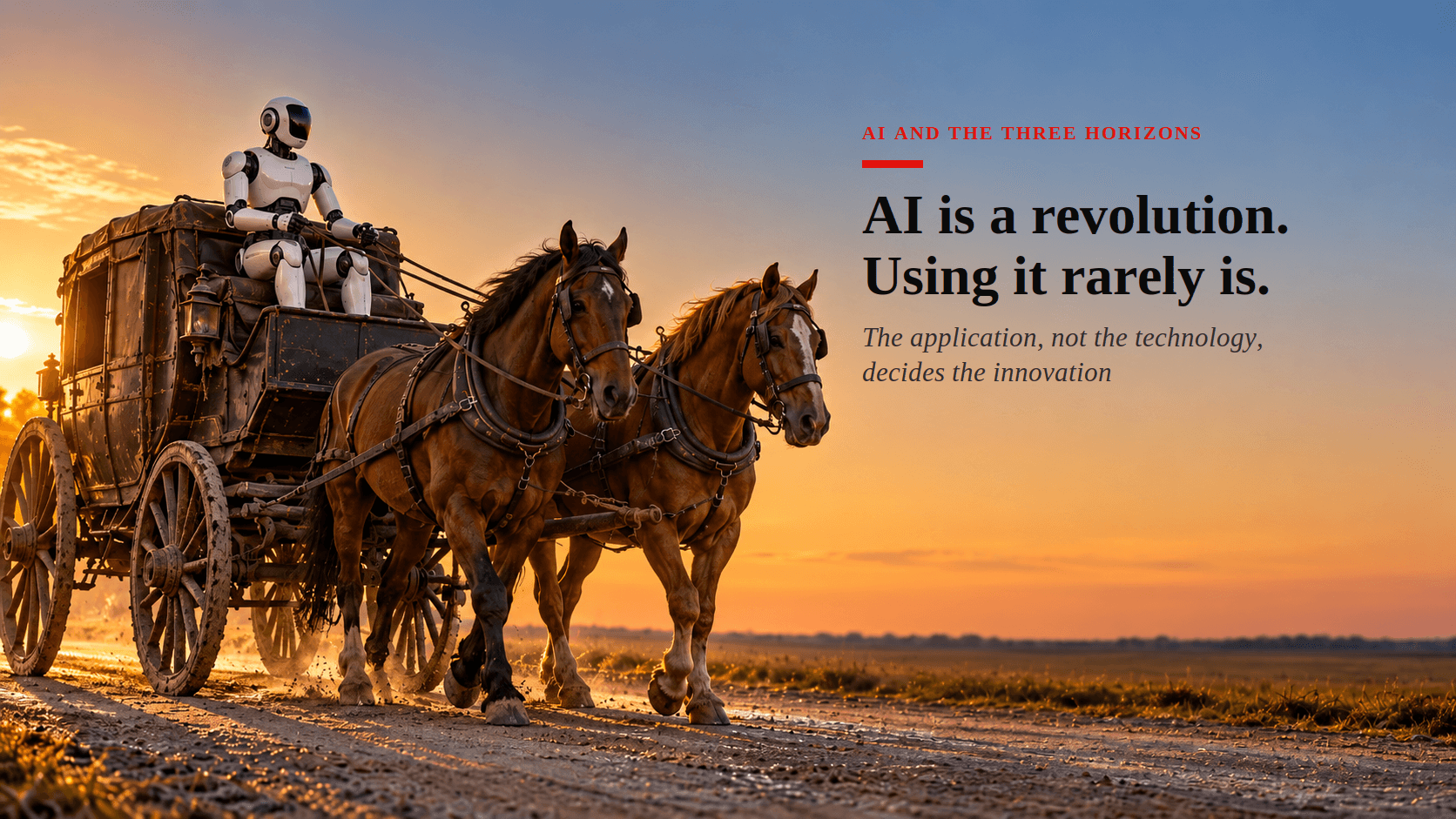
Same AI, Three Horizons: Why the Application Decides the Innovation

The models behind today’s AI are one of the great innovations of our time. For the companies that use them, however, the model alone changes little. This post argues that what decides whether AI changes a business is the way it is applied, and that this can be placed on three horizons of innovation. A short detour via drones shows how easily we are dazzled by technology. The car industry then serves as the running case: AI optimizing the combustion engine, AI in the electric car, and AI in new forms of mobility. Two thinking tools carry the analysis, a simple test of what stays the same in each horizon and the distinction between complicated and complex problems from the Cynefin framework. At the end you will find six lessons that apply to any industry.
The three horizons of innovation: why a summarized inbox is not a revolution
Every week brings a new revolution. AI summarizes the inbox, drafts the minutes, writes the first version of the quarterly report. All of this is useful. None of it is a revolution. I wrote this post at the AI@Strategy Conference 2026 in Munich, between talks about what AI will do for strategy.
We are easily dazzled by technology. Whenever high tech is applied, we assume the application must be innovative. Take a drone that carries laboratory samples between two hospitals. It flies, it navigates on its own, it looks like the future. In 2017 Swiss Post and the Ticino hospital group EOC began flying lab samples between two hospitals in Lugano, samples that until then had travelled by road. Now ask what stays the same: the hospitals, the samples, the job of getting them to the lab quickly and the logistics provider. A drone replaces a van. Had a bicycle courier replaced the van, faster through the traffic jams and just as reliable, nobody would have called it innovation. The drone is horizon 1, however futuristic it looks, and Swiss Post itself saw drones as a complement to its parcel delivery. In 2022 Swiss Post handed the operation over to its drone supplier Matternet, because it could not use drones widely enough or run them at a profit.
The same family of technology can also change the rules of an entire field. In Ukraine, first-person-view drones that cost $300 to $400 apiece now cause, by the account of Ukraine’s National Security and Defense Council, 60 percent of the Russian army’s losses. Ukraine says it produces ten million drones a year and wants to double that. Most of the damage on the front is now done by a disposable drone. What changed is the cost equation: a weapon cheap enough to lose, produced in the millions, against equipment worth millions per unit.
High tech is not innovative by itself. It becomes innovative through what we do with it.
The same holds for AI, and here I want to be precise, because this is easy to misread. The development of the AI models themselves is a remarkable innovation. Machines that write, translate, code and reason at this level did not exist a few years ago, and the labs that built them have created entirely new business models. But for a bank, an insurer or a carmaker, the model is an input. Everyone can rent it. The hype begins where the innovation of the model is mistaken for an innovation of the company that uses it.
For more than ten years I have used the three horizons model in executive education and consulting. The model goes back to Baghai, Coley and White (1999), who argued that companies have to manage today’s core business, emerging businesses and options for the future at the same time. Steve Blank (2015) connected the horizons with business models, and in 2019 he made the case that the horizons are no longer bound by time.
One slide has stayed in my deck through every revision:
Technology does not decide the horizon of an innovation. How innovatively it is applied does.
That sentence is the best antidote to the AI hype I know. It moves the question from “how powerful is the model?” to “what does it change in our business model?” And for most of what is celebrated today, the honest answer is: nothing.
Two thinking tools for the three horizons: what stays the same, and is it complicated or complex?
The first tool is a single question. What stays the same when we apply AI?
- Horizon 1: Everything stays the same. The starting point is today’s product and today’s processes. Customers, competitors and the business model are unchanged. Current customers understand the improvement and like it.
- Horizon 2: Parts of the business model change, typically the value creation architecture. The customer and the customer’s need stay the same, but the way value is created for them is rebuilt.
- Horizon 3: Only the customer’s job to be done stays. Everything else is open: the customer, the offering, the revenue model, the competitors. In the beginning the customers are often new, and the competitors come from other industries.
The horizon, in other words, is not a property of the technology. It is a relationship between an application and an existing business model. The same AI can be horizon 1 for one company and horizon 3 for another.
The second tool comes from the Cynefin framework of Snowden and Boone (2007). It separates complicated problems from complex ones. The car industry offers the clearest illustration. A combustion engine is complicated: experts can take it apart, calculate it and optimize it, and it behaves tomorrow as it did today. Traffic is complex. It emerges from thousands of drivers who react to each other. Nobody designs a traffic jam. It simply happens. In a complicated context, cause and effect can be discovered by experts. Existing know-how is adequate, and the leader’s job is to sense, analyze and respond. Stage-gate processes, project management and strategic planning work well here.
In a complex context, only parts of the problem can be defined. Many agents interact and adapt to each other, outcomes are unpredictable, and there are no right answers waiting to be found, only patterns that emerge. Existing know-how is inadequate and can even be outright dangerous. The leader’s job becomes probe, sense and respond. The tools change accordingly: business model thinking, customer insight, design thinking, agile methods and discovery-driven planning.
Put the two tools together and the horizons stop being a taxonomy. They become a management map:
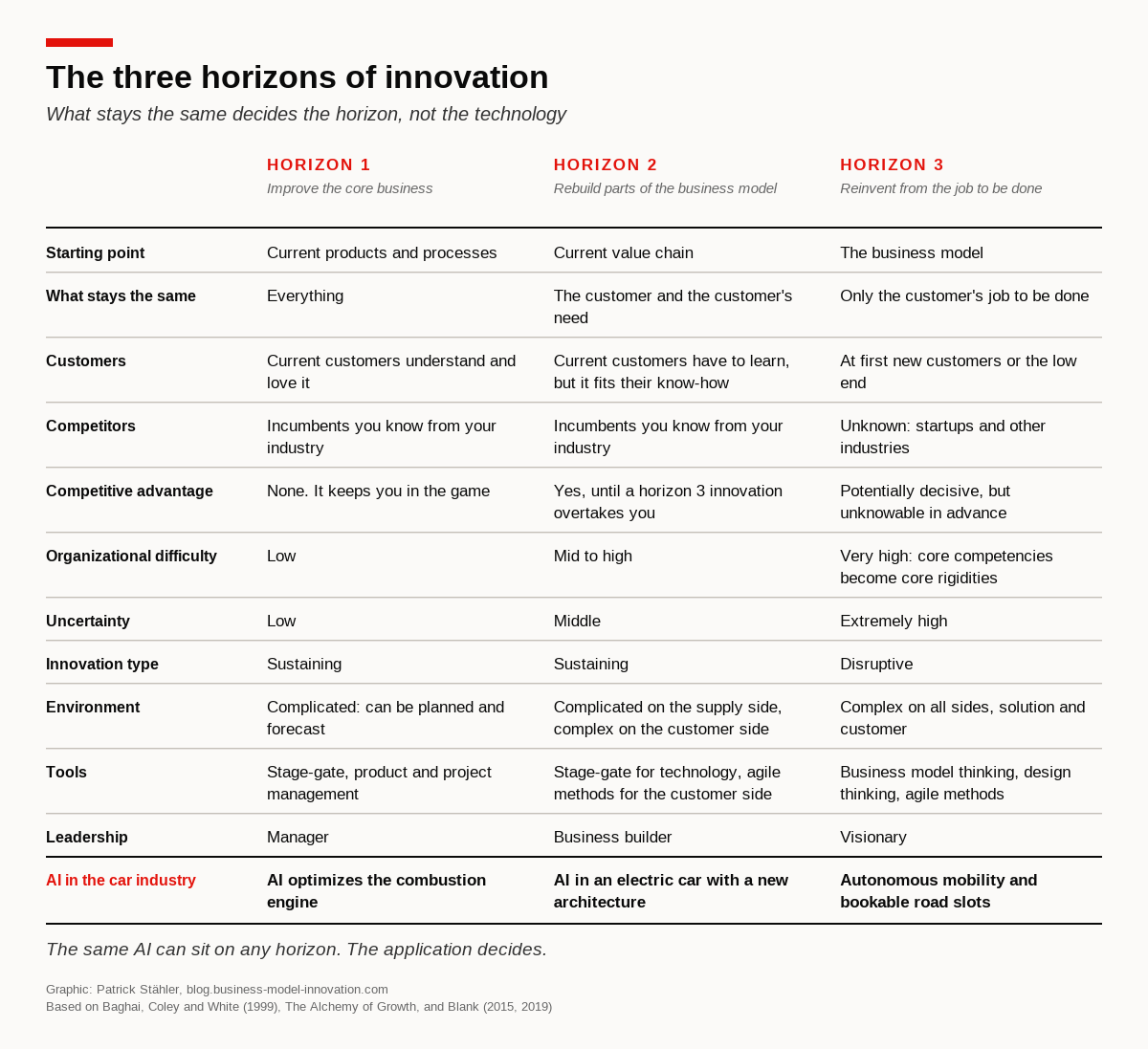
- Horizon 1 is complicated. It can be planned and forecast.
- Horizon 2 is complicated on the supply side and complex on the customer side.
- Horizon 3 is complex on all sides, the solution as well as the customer.

Known unknowns and unknown unknowns: what experience is worth on the three horizons
The row of the graphic I find most useful in practice is the knowledge pattern.
In a complicated context we face known unknowns. We know what we do not yet know, and we know how to find it out. How much fuel does an engine need at 2,000 rpm and full load? Nobody knows before the test bench, but everybody knows the question, the method and the expert who can answer it. Existing know-how is adequate. More data and better analysis close the gap, and this is exactly where AI is strongest.
In a complex context we face unknown unknowns. We do not know what we are missing, because the decisive questions have not yet appeared. Will people in fifteen years want to own a car, rent a seat or book a slot on a road? Nobody can list the right questions in advance, because the answers emerge from how customers, cities, regulators and competitors react to each other. Here existing know-how is inadequate, and it can be outright dangerous: it makes the familiar questions look like the only ones.
The distinction echoes Frank Knight (1921), who separated risk, which can be calculated, from uncertainty, which cannot. It also explains why experienced organizations struggle most on horizon 3. On horizon 1, a carmaker’s decades of combustion know-how are its greatest asset. On horizon 3, the same know-how answers questions nobody is asking any more, and it answers them with great precision. Dorothy Leonard-Barton (1992) called this the moment when core capabilities turn into core rigidities.
The more you know about the old answers, the harder it is to notice that the questions have changed.
Now let us run the car industry through both tools.
Horizon 1: AI optimizes the combustion engine to perfection
A modern combustion engine is run by a control unit that decides, at every combination of speed, load and temperature, when and how much fuel to inject, how much exhaust gas to recirculate and at what pressure to work. Calibration means tuning all of these maps so that the engine is frugal, meets the emission standard and is still fun to drive. Traditionally this takes months on the test bench. Think of tuning a piano in which every string is tied to every other string, with the regulator sitting in the audience.
This is exactly where machine learning shines. In 2022, Mazda licensed an active-learning platform from Secondmind to automate the calibration of its SKYACTIV engines, expecting to more than double the efficiency of the process. In research, Vlaswinkel, Antunes and Willems (2025) let a self-learning method shape the pressure curve inside the cylinder towards an idealized thermodynamic cycle.
It is a genuine achievement. It is also the automotive equivalent of using AI to send a better fax.
Combustion is hard. It is not complex. A piston does not read the news, does not change its mind and does not defect to a Chinese competitor. Customers do. In the Cynefin sense the engine is complicated: difficult and high-dimensional, but in the end a machine that experts and their algorithms can analyze. That is why AI is so good at it.
And there is a wall. You cannot calibrate your way past Carnot. In 1824 Sadi Carnot showed that every heat engine has a ceiling set by the temperatures it works between. Physics set that wall for the combustion engine two centuries ago, and the best AI can only bring it closer. The road is not a test bench either: record figures are measured at the combustion engine’s sweet spot, not in a traffic jam on a cold Monday morning.
So what does horizon 1 buy you? The slide is blunt: no competitive advantage. It has to be done to stay in the game. Michael Porter (1996) made the same point decades ago: operational effectiveness is not strategy, because competitors can imitate it. With AI this is truer than ever. Every manufacturer can rent the same models. An improvement you can buy, everyone can buy.
This is why the popular story of the highly efficient combustion engine that will rescue the German car industry is so seductive and so dangerous. I discussed one version of it in the post on HVO100 and the combustion-engine ban. The engineers are doing excellent work. Their excellence is simply pointed at the wrong target. In Clayton Christensen’s terms, the AI-optimized combustion engine is a sustaining innovation: it makes a good product better for the customers who already buy it. That is exactly what makes it dangerous. It works, and as I described in The Firebugs in the Attic, sustaining innovation never turns into business model innovation on its own.
Horizon 2: the electric car rebuilds the value creation architecture
The electric motor is not a heat engine. It does not stand in front of Carnot’s wall at all. That alone tells you the electric car is not an optimization of the old system but a change of one of its building blocks.
Run it through the test. The customer still buys a car, and the job stays the same. What changes is the value creation architecture: the battery replaces the engine as the core component, software becomes part of the product, the supplier base is reshuffled and the relationship with the customer continues after the sale. AI helps here as well, for instance in managing the battery or the energy flows in the car. But AI is not what puts the electric car into horizon 2. The new architecture does. I have argued in The Powertrain Race Was Never a Technology Contest why the battery already won as a business model.
The environment shifts as well. On the supply side, horizon 2 is still complicated: cell chemistry, thermal management and production can be engineered and planned. On the customer side it is complex. How people charge, how they think about range, what they expect from a car that updates itself overnight: none of this can be fully analyzed in advance. It has to be learned from customers who are already driving.
Horizon 2 can create a competitive advantage, and the best illustration comes from the combustion era itself. Toyota’s production system did not improve a single product or process. It rebuilt the architecture of how cars are made and how suppliers work with the manufacturer, while the business model of selling cars to customers stayed the same. That advantage lasted for decades because it sat in the system, not in a part that could be copied. The slide adds the necessary caveat: the advantage holds as long as no horizon 3 innovation kills you.
Horizon 3: start with the job, not with the car
In horizon 3 the question is no longer “how do we build a better car?” Only the jobs remain. How do people get from A to B? How do goods get to where they are needed? Everything else is up for redesign.
Starting from the job opens options that have very little to do with a carmaker’s business model today. Autonomous vehicles that are used as a service rather than owned. Systems that distribute existing traffic over the day, with bookable slots for certain routes, the way airports allocate landing slots, instead of building more roads. New roads change the very traffic they are meant to relieve: Duranton and Turner (2011) found that in US cities, additional road capacity was largely met by additional driving. Here AI is no longer a tool applied to the product. It becomes part of the offering itself, the driver in the autonomous car and the coordinator of the slot system.
These are options, not forecasts. As Baghai, Coley and White put it, horizon 3 is about creating viable options for the businesses of tomorrow. Nobody can analyze their way to the answer, because the answer depends on how customers, cities, regulators, insurers and competitors react to each other. This is complex on all sides, and it is where disruptive innovation lives. The only way forward is to probe: small, cheap experiments that reveal which configuration of the business model customers actually adopt.
There is a final point on the slide that I have never had to revise: new competitors do not care about the past, and they already compete in horizons 2 and 3 today. The danger of horizon 3 is not that it arrives in ten years. It is that someone else is already working on it while you optimize.
Every horizon needs different people
If the horizons differ in uncertainty, they also differ in the people and tools they need. Baghai, Coley and White already stressed that the horizons need different talent. In my slides the leadership style moves from manager in horizon 1 to business builder in horizon 2 and visionary in horizon 3. The tools move from stage-gate and project management to agile methods on the customer side and finally to business model thinking and design thinking.
This is where most AI programs fail, and the reason is human, not technical. An AI program that is run by horizon 1 managers with horizon 1 tools will deliver horizon 1 results: faster processes, lower costs, a better fax. That is not a failure of the technology. It is a question of the fourth element of every business model, the spirit of the enterprise, its team and its values. Whoever forgets the people forgets what it takes to drive change.
Resistance follows the same pattern. In horizon 1 it is low, because the improvement fits into daily business. In horizon 3, incumbents often do not even understand what is going on, because their core competencies have quietly turned into core rigidities.
Lessons learned: how to place AI on the three horizons
- Determine the horizon by your business model, not by the technology. Ask what stays the same. If the answer is “everything”, it is horizon 1, however impressive the demo.
- Do horizon 1, but do not call it strategy. AI efficiency is necessary to stay in the game. It does not win the game, because everyone can rent the same models.
- Know your wall. Every optimization approaches a limit, physical like Carnot’s or economic like the margin of a mature product. Ask how close you already are.
- Ask whether the problem is complicated or complex before you choose the tools. Analysis works for the engine. Traffic needs probing, and a business case written for the engine will kill a mobility project.
- Start horizon 3 from the job to be done. Do not ask what AI can do for your product. Ask how the customer’s job could be done in a completely different way, and what role AI could play in that.
- Staff each horizon with the right people. Managers, business builders and visionaries are not interchangeable. An AI program led by the wrong people will produce the wrong horizon.
AI will change a great deal. But it will not do so on its own. The revolution, if there is one, lies in the application.
Understand. Imagine bigger. Act.
Annotated bibliography
Baghai, M., Coley, S., & White, D. (1999). The Alchemy of Growth: Practical Insights for Building the Enduring Enterprise. Reading, MA: Perseus Books. Publisher page The origin of the three horizons model: companies must manage their core business, emerging businesses and options for the future simultaneously, each with its own talent and management approach.
Blank, S. (2015, June 26). Lean Innovation Management – Making Corporate Innovation Work. steveblank.com. Link Combines the three horizons with the Lean Startup and defines the horizons by whether a business model is being executed or searched for.
Blank, S. (2019, February). McKinsey’s Three Horizons Model Defined Innovation for Years. Here’s Why It No Longer Applies. Harvard Business Review. Link (first published as The Fatal Flaw of the Three Horizons Model, January 8, 2019) Argues that the horizons are no longer bound by time, because disruptors can repurpose existing horizon 1 technologies into new business models very quickly.
Carnot, S. (1824). Réflexions sur la puissance motrice du feu (Reflections on the Motive Power of Fire). Paris: Bachelier. Overview Establishes that the maximum efficiency of any heat engine is limited by the temperatures between which it operates, the physical wall behind every combustion engine.
Christensen, C. M. (1997). The Innovator’s Dilemma: When New Technologies Cause Great Firms to Fail. Boston: Harvard Business School Press. Overview Distinguishes sustaining innovations, which improve products for existing customers, from disruptive ones, which start with new or low-end customers and eventually overturn incumbents.
Duranton, G., & Turner, M. A. (2011). The Fundamental Law of Road Congestion: Evidence from US Cities. American Economic Review, 101(6), 2616-2652. Link Shows that vehicle kilometers traveled in US cities rise roughly in proportion to new highway capacity, so building roads is unlikely to relieve congestion.
Knight, F. H. (1921). Risk, Uncertainty, and Profit. Boston and New York: Hart, Schaffner & Marx; Houghton Mifflin. Full text at Econlib Separates risk, whose probabilities can be known and calculated, from true uncertainty, which cannot be measured and is the source of entrepreneurial profit.
Leonard-Barton, D. (1992). Core Capabilities and Core Rigidities: A Paradox in Managing New Product Development. Strategic Management Journal, 13(S1), 111-125. Link Shows how the capabilities that make a firm successful can turn into rigidities that block new development.
Porter, M. E. (1996). What Is Strategy? Harvard Business Review, 74(6), 61-78. Link Distinguishes operational effectiveness from strategy: improvements that competitors can imitate do not create a lasting advantage.
Sargut, G., & McGrath, R. G. (2011). Learning to Live with Complexity. Harvard Business Review, 89(9), 68-76. Link Explains why complex systems behave differently from complicated ones and what this means for forecasting and management.
Secondmind (2022, January 17). Secondmind Licenses Active Learning Platform to Mazda to Increase Powertrain Design and Development Efficiency and Accelerate Development of Cleaner Vehicles. Business Wire. Link Press release on Mazda’s use of machine learning to automate engine calibration, with Mazda expecting to more than double the efficiency of the process.
Snowden, D. J., & Boone, M. E. (2007). A Leader’s Framework for Decision Making. Harvard Business Review, 85(11), 68-76. Link Introduces the Cynefin framework and the distinction between complicated contexts (sense, analyze, respond) and complex contexts (probe, sense, respond).
Vlaswinkel, M., Antunes, D., & Willems, F. (2025). Automated and Risk-Aware Engine Control Calibration Using Constrained Bayesian Optimization. arXiv preprint 2503.20493. Link Presents a self-learning calibration method that shapes the in-cylinder pressure curve towards an idealized thermodynamic cycle to maximize thermal efficiency.
