
Imagine Bigger with AI: It Can Read the Languages of Life. Why Do We Use It to Summarize Emails?

This post argues that the most important thing AI does is to let us see what we could not see before. It was triggered by a talk by Prof. Fabian Theis at the AI@Strategy Conference in Munich. Two cases carry it: AlphaFold and the structure of proteins, and the Human Cell Atlas, which turned some 200 known cell types into thousands. Both show that new sight is the precondition for imagining bigger. The post then explains why most companies are repeating with generative AI the mistake they made in the first phase of digitalization, a mistake I already observed while writing my dissertation in 2001. It is meant as a call to action: use AI to imagine bigger. At the end you will find a simple exercise for your team and five lessons that apply to any industry.
Generative AI as a new way of seeing: what a talk on the Human Cell Atlas reminded me of
I am not a biologist. Years ago, Richard Socher planted an idea in my head that I have carried through my lectures ever since: AI is at its most fascinating where it lets humans understand languages they could never read, such as DNA, RNA or proteins. Socher worked on exactly that. With colleagues at Salesforce Research he trained ProGen, a language model, on some 280 million protein sequences. In his new book, The Eureka Machine (2026), he takes the idea further: AI’s biggest breakthrough, he writes, won’t be a chatbot, because “a model can eventually learn the language of biology.” The Human Cell Atlas became one of my examples for his idea.
On October 8, I had the honor of hearing Fabian Theis speak at the AI@Strategy Conference 2026 in Munich. Theis directs the Computational Health Center at Helmholtz Munich, holds a chair at TUM and sits on the board of directors of the Human Cell Atlas. He is also one of the authors of the 2017 paper that first laid out the atlas.
Listening to him, I was struck by how far apart two worlds have drifted. Biology has been using AI for years to see what no microscope could show. In the post on the three horizons I argued that the application decides the innovation. This post adds the other pole.
The greatest application of AI is not to do faster what we already do. It is to see what we could not see. And seeing is where imagining bigger begins.
Protein folding: fifty years of looking, then a picture
Proteins are chains of amino acids that fold into a three-dimensional shape, and the shape decides what the protein does. Predicting that shape from the sequence was an open problem for about fifty years. In 2020, Demis Hassabis and John Jumper of Google DeepMind presented AlphaFold2. According to the Nobel committee, it has predicted the structure of virtually all 200 million proteins researchers have identified and has been used by more than two million people in 190 countries. In 2024 it earned the two the Nobel Prize in Chemistry.
I have used protein folding in lectures for years because it makes the point in one picture. The sequence was always there. What was missing was the ability to read it.
None of this is new. In July 2021, more than a year before ChatGPT appeared, Nature’s editors wrote that artificial intelligence in structural biology is here to stay, and that the predictions are valuable precisely because data and methods are open. Science saw the new way of seeing long before the rest of us started asking AI to write our emails.
One precision matters. AlphaFold predicts what the folded protein looks like. It does not explain how the chain gets there: Outeiral, Nissley and Deane (2022) found that structure predictors tell us very little about the folding pathway. AI gave biologists new eyes. Understanding still has to be built by people, in experiments.
This is also where the Cynefin framework helps. Biology is complex: no expert could have listed the answers in advance. In a complex context, leaders probe, sense and respond. AI strengthens the sensing. It delivers a better picture, and the next experiment starts from there.
From 200 cell types to thousands: how the Human Cell Atlas lets us imagine bigger
For a long time the textbook said we are built from around 200 types of cells. The Human Cell Atlas has revealed thousands, some of which appear to play a role in diseases such as inflammatory bowel disease and cystic fibrosis. The microscope showed what a cell looks like. Single-cell genomics, combined with computational analysis, reads which genes are active in each individual cell, and so differences appear that were always there and never visible.
This is what new sight does. It enlarges the space of what we can imagine. As long as there were 200 cell types, nobody could think of a therapy aimed at one of the thousands we did not know. What we cannot see, we cannot imagine. What we cannot imagine, we cannot build.
Here generative AI leaves text behind. Sarah Teichmann, the atlas’s founding co-chair, described its data as training material for foundation models, a kind of ChatGPT for cells that helps researchers annotate new cells and find rare ones among tens of millions of profiles (Reuters, republished by FBC News). The same principle that writes our emails learns the language of cells.
Why generative AI repeats the mistake of the first digitalization
This is where my frustration begins, and it is not new. In 2001 I wrote my dissertation on business models in the digital economy. Most companies then treated the internet as a channel. The catalog became a website, the branch an online form. Few asked which new business model the technology made possible. Years later, German publishers still saw the Kindle as a new distribution channel. Twenty years after the dissertation, I had to ask again why incumbents still struggle with business model innovation.
Twenty-five years after the dissertation, I watch the same pattern with AI. The technology that reads the language of proteins is used to draft the minutes. Efficiency is welcome. It measures how well we do something. Whether it is still the right thing to do is a question efficiency cannot answer. As I described in The Firebugs in the Attic, that is precisely what makes it dangerous: it works.
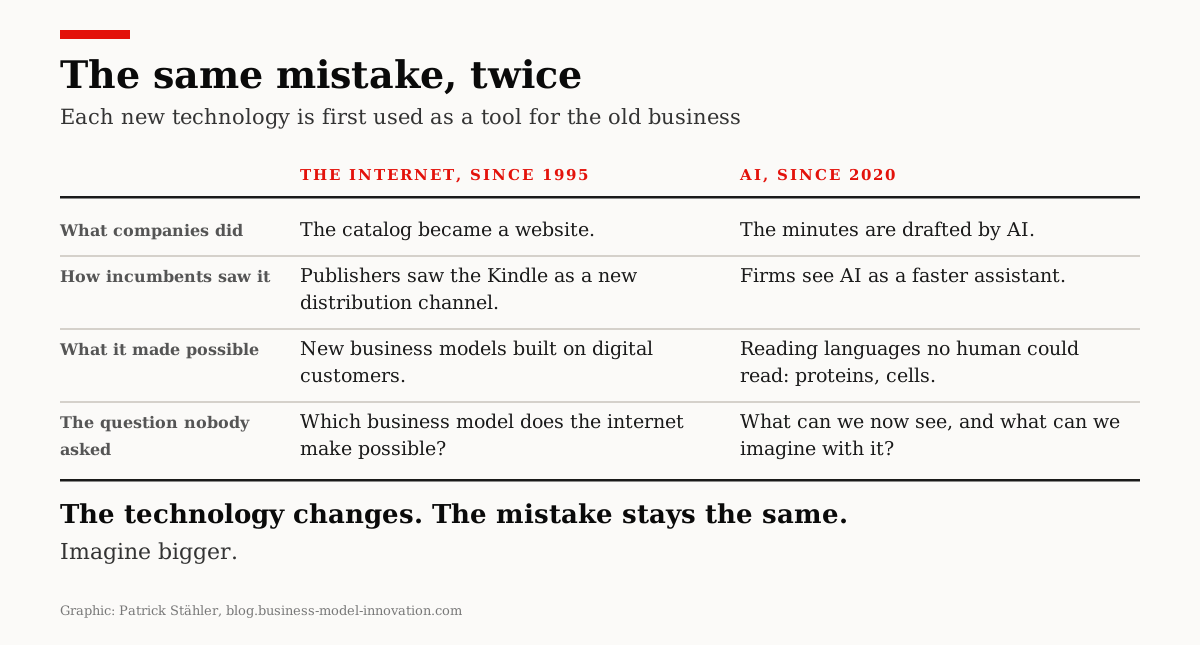
Generative AI learns the grammar of a language and produces new sentences in it. That principle works wherever a field has a language nobody could read so far. Biology found its languages first. Every industry should be asking where its own are. The sensor data of a machine fleet, the patterns in thousands of customer conversations, the logic of a supply network: what would we see if we could read them?
We are not short of technology. We are short of imagination about what it lets us see.
Imagine bigger: a call to put AI to work on what you cannot yet see
Imagination is a strategic capability, and it can be learned. Until now, imagining bigger mostly meant stretching beyond what we knew by an effort of will. AI opens a second route. It shows us what we did not know was there, and our imagination can start from a larger picture. Seeing has a second side as well: every business model also runs on assumptions we stopped seeing. A new view of the world is often the moment they become visible again.
So here is my request. Before you approve the next AI project that saves time, take one afternoon with your team and work through three questions:
- See: Which language in our field could nobody read so far?
- Imagine: If we could read it, which customers, jobs and business models would suddenly become thinkable?
- Act: What is the smallest experiment that would show us whether one of them is real?
The first question is about AI. The second is about you. No model will answer it for you, and it is the one that decides whether AI becomes a revolution in your company or a faster way to write the minutes.
Lessons learned: how to imagine bigger with generative AI
- Ask what AI makes visible before you ask what it makes faster. The most valuable findings are the ones you did not know to look for.
- Find the unreadable language in your own field. Every industry has data it collects and cannot read. That is where AI starts to change the questions you ask.
- Let new sight enlarge what you imagine. Every new view is an invitation to ask which business models have just become thinkable.
- In complex situations, use AI to sense. AI gives you a better picture. Judgment and responsibility remain human.
- Check whether you are digitizing a channel or redesigning a business model. If everything stays the same after the AI project, it was horizon 1, however impressive the demo.
AI can show us more than any generation before us has seen. Whether we imagine bigger with it is up to us.
Understand. Imagine bigger. Act.
Annotated bibliography
Jumper, J., Evans, R., Pritzel, A., et al. (2021). Highly accurate protein structure prediction with AlphaFold. Nature, 596, 583-589. Link Presents AlphaFold2, which predicts protein structures from amino-acid sequences with near-experimental accuracy.
Madani, A., McCann, B., Naik, N., Keskar, N. S., Anand, N., Eguchi, R. R., Huang, P.-S., & Socher, R. (2020). ProGen: Language Modeling for Protein Generation. arXiv preprint 2004.03497. Link Treats protein engineering as a language problem and trains a 1.2-billion-parameter language model on about 280 million protein sequences.
Nature (2021, July 27). Artificial intelligence in structural biology is here to stay. Editorial. Nature, 595, 625. Link Argues, more than a year before ChatGPT, that AI-predicted protein structures are transforming structural biology and that their value depends on open data and methods.
Nobel Prize Outreach (2024, October 9). The Nobel Prize in Chemistry 2024. Press release. Link Awards half the prize to Demis Hassabis and John Jumper for protein structure prediction and describes AlphaFold2 as the solution to a 50-year-old problem.
Outeiral, C., Nissley, D. A., & Deane, C. M. (2022). Current structure predictors are not learning the physics of protein folding. Bioinformatics, 38(7), 1881-1887. Link Shows that the pathways generated by structure predictors, including AlphaFold2, are no better than chain length at predicting folding kinetics, so structure prediction is not an understanding of folding.
Regev, A., Teichmann, S. A., Lander, E. S., et al. (2017). The Human Cell Atlas. eLife, 6, e27041. Link The founding paper of the Human Cell Atlas: defines all human cell types by molecular profiles and commits the project to open data, code and community.
Snowden, D. J., & Boone, M. E. (2007). A Leader’s Framework for Decision Making. Harvard Business Review, 85(11), 68-76. Link Introduces the Cynefin framework and the distinction between complicated contexts (sense, analyze, respond) and complex contexts (probe, sense, respond).
Socher, R. (2026). The Eureka Machine: Why AI Is the Key to Unlocking a New Era of Scientific Discoveries. New York: PublicAffairs. Link Argues that AI’s greatest impact will be on scientific discovery, with models learning the language of biology and accelerating breakthroughs across medicine, biology and other fields.
Stähler, P. (2001). Geschäftsmodelle in der digitalen Ökonomie: Merkmale, Strategien und Auswirkungen. Dissertation, University of St. Gallen. ResearchGate The dissertation that established the business model as a unit of analysis and design for the digital economy.
