Anthropic’s Business Model: What the S-1 Finally Reveals

Until October 26, 2026, what outsiders knew about the Anthropic business model came largely from leaks and estimates. That day, the company filed its S-1 for an IPO with the U.S. Securities and Exchange Commission. For the first time, we can read how Anthropic makes money in its own, legally binding words. This post describes Anthropic’s business model with the Four-Element Business Model I have used for the last 20 years: value proposition, value creation architecture, revenue model and corporate spirit (team and values). Most of the space goes to one connection the headline numbers hide: how the architecture and the economics of the technology write the cost side of the business. The post describes rather than judges. The interdependencies and the lessons for other industries follow in a second post on the defensibility of its business model. The research for this post was done with Claude, an AI model built by Anthropic; every figure has been checked against the filing.
Update, November 3, 2026: Anthropic has since amended its S-1 with the third quarter of 2026; the main changes are listed in an addendum at the end of this post.
What Anthropic’s S-1 reveals about the Anthropic business model
The S-1 is a registration statement for an initial public offering. It is long, it is lawyered, and it carries liability. What the company writes there, it has to stand behind. That makes it the best primary source on a business model that any frontier AI lab has ever published.
The numbers are what everyone quotes. Revenue went from 41 million dollars in 2023 to 386 million in 2024 and 4.6 billion in 2025. In the first half of 2026 it reached 16.3 billion, of which 11.6 billion fell in the second quarter alone (S-1, p. 23 and p. 158). In that quarter, Anthropic made its first operating profit: 974 million dollars (S-1, p. 160).
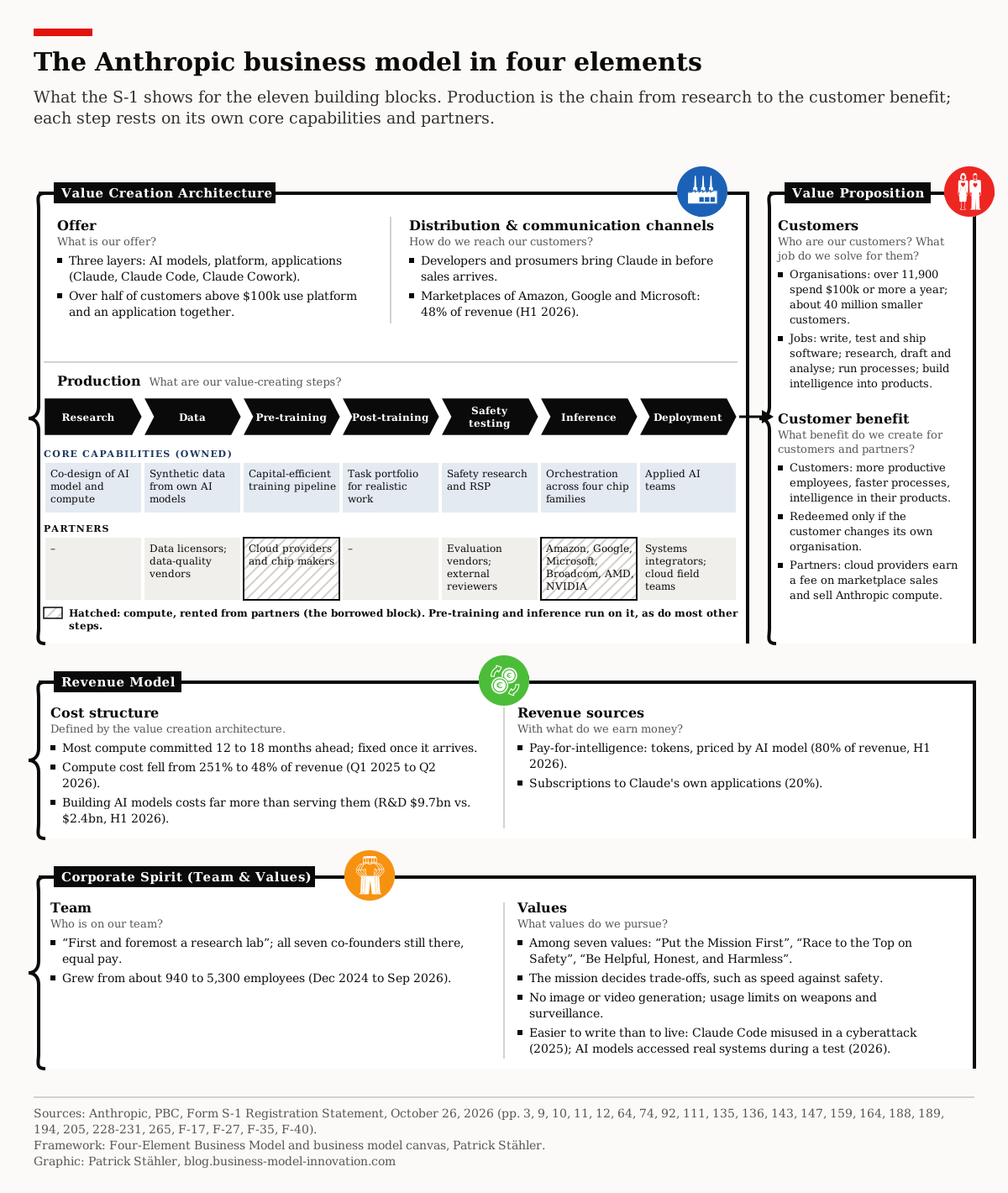
Numbers like these invite the question of which AI model is better. I want to ask a different one. Anthropic’s revenue shows that its value proposition works. It does not show whether the whole business model works, because it says nothing about who captures the value. Answering that requires looking at all four elements. In the Four-Element Business Model, a business model is the system of four interdependent elements: value proposition, value creation architecture, revenue model and corporate spirit (team and values).
The S-1 lets us see all four. One term needs settling first. Throughout this post, I write “AI model” for Claude and its siblings and “business model” for the business. The two are easy to confuse.
Value proposition: Anthropic sells productivity to organisations
Anthropic promises its customers three kinds of benefit: “more productive employees, faster processes, and embedded intelligence in their products” (S-1, p. 228). Read as a ladder, the three steps show how deep Claude goes into the customer’s business.
On the first step, an individual sees what an AI model does to their own output. The conviction spreads to the team, then to the company. On the second, in Anthropic’s words, “Claude stops being something employees consult and starts being something the organization runs on” (S-1, p. 228). On the third, the customer builds Claude into its own products. What the customer buys on every step is the benefit: work done faster and better.
Who pays Anthropic: 11,900 organisations spending over 100,000 dollars a year, and 40 million smaller customers
Who the customer is matters as much as what is promised. Anthropic distinguishes two kinds of customer: prosumers and organisations (S-1, p. 3). It keeps no internal category called “enterprise”. Instead, it counts organisations that spend at least 100,000 dollars over twelve months. By September 30, 2026, there were more than 11,900 of them, next to roughly 40 million smaller customers (S-1, p. 9 and p. 143).
What they hire Claude for is concrete work. Claude Code writes, tests, debugs and commits code; Claude Cowork researches, drafts, analyses and executes other knowledge work (S-1, p. 10).


These are customers, not a market: identifiable, countable, and visible in the numbers when they buy more. A Claude Enterprise user without Claude Code spent less than 75 dollars a month in the third quarter of 2026. The top five per cent of users with Claude Code spent about twenty times that (S-1, p. 196).
Ben Thompson put the logic of this choice plainly in Agents Over Bubbles. Companies have a demonstrated willingness to pay for software that makes their employees more productive; consumers mostly do not. Anthropic built its value proposition around the customer who pays.
Why customers have to change their own organisation to get the value
One obstacle to this value proposition sits with the customer: “the natural resistance to change within organizations” (S-1, p. 237). Adoption requires workforce retraining, process redesign and “shifts in corporate culture” (S-1, p. 237). Anthropic’s value proposition is only redeemed if the customer changes its own organisation.
Luis Garicano and Jesús Saa-Requejo reach the same point from economics in Three theses on AI value capture. Most of the value, they argue, depends on workflow redesign and organisational authority. The intelligence of the AI model is not the bottleneck. Jürg Stuker shows what this looks like in practice in Agents Teams und Organisationslehre. As soon as agents work in teams, the old questions of span of control and responsibility come back. Project roles start to merge.
Value creation architecture: how the Anthropic business model produces and delivers Claude
Three layers: AI models, platform and applications
Anthropic’s offer comes in three layers: AI models, a platform and applications. “An advance at any layer compounds across all three layers” (S-1, p. 182). The platform offers customers the same building blocks that Anthropic uses for its own applications (S-1, p. 10). More than half of the customers above 100,000 dollars now use the platform together with at least one of Anthropic’s own applications. At the end of 2025, it was about 30 per cent (S-1, p. 135).
Thompson explains in the same article why this matters for the business model. Agents need an AI model and a “harness”, the software that steers the AI model and checks its results. Profit tends to flow to the integrated parts of a value chain, and away from the modular ones that become commodities. Whoever integrates AI model and harness is harder to replace than whoever supplies only the AI model.
How Claude reaches customers: through developers first, then through the cloud providers
Distribution is the second building block, and here the architecture is unusual. A large part of the growth “has been self-service and organic” (S-1, p. 143). Developers and prosumers bring Claude into their organisations before any sales team arrives. “By the time our direct teams engage a customer, Claude is often already in use” (S-1, p. 140). The direct teams and the Applied AI teams work as one “hybrid sales and engineering function” (S-1, p. 194): the people who sell Claude also help to put it to work.
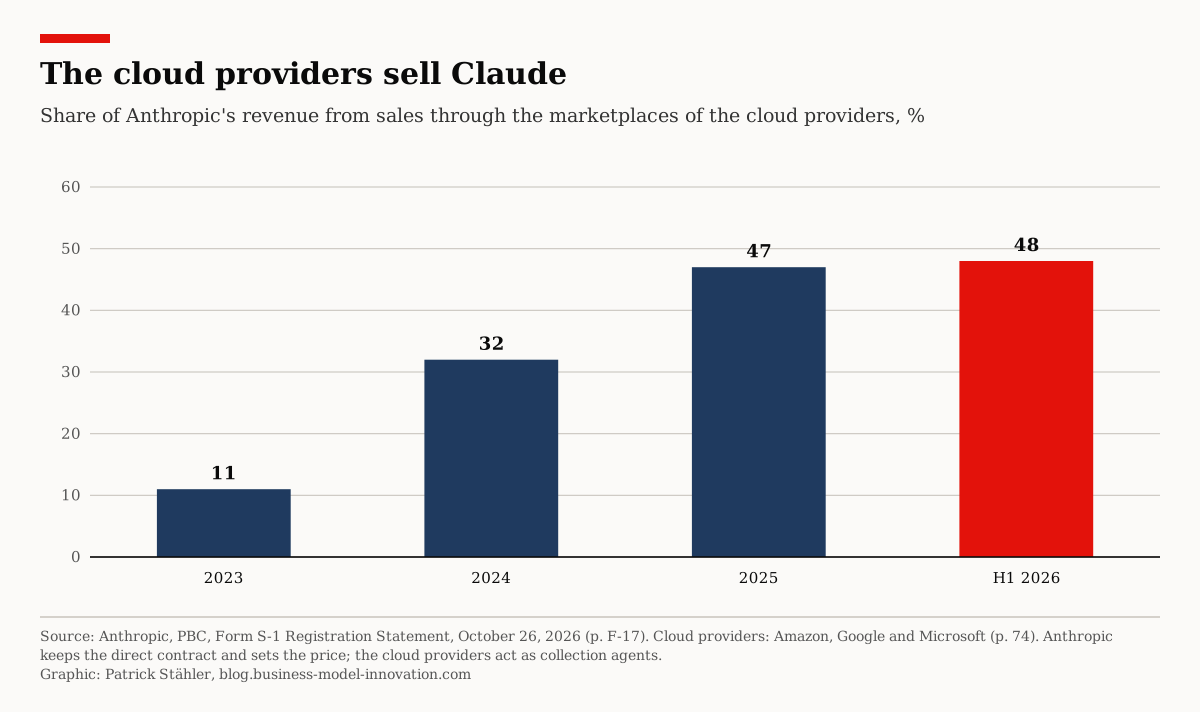
Alongside, Anthropic sells through Amazon, Google and Microsoft. Their cloud marketplaces brought in 48 per cent of revenue in the first half of 2026, up from 11 per cent in 2023. Anthropic keeps the direct contract and sets the price (S-1, p. F-17 and p. F-22).
Production: from research to the customer benefit
Production, the value-creating steps, is the third building block. It runs from research through data, pre-training, post-training and safety testing to inference and deployment at the customer. Researchers test each proposed improvement at small scale before it may consume large amounts of compute, and frontier training runs are “planned, scheduled capital deployments” (S-1, p. 188). Training data comes from the public web, scanned books, licensed datasets and synthetic data generated by Anthropic’s own AI models (S-1, p. 92). Post-training “has grown from a finishing step into a major research investment” (S-1, p. 188). Every AI model is tested before release, and a release can be delayed or restricted (S-1, p. 231). Applied AI teams with forward-deployed engineers then help customers build Claude into their own systems (S-1, p. 194). What Anthropic learns there flows back into the next AI model (S-1, p. 11).
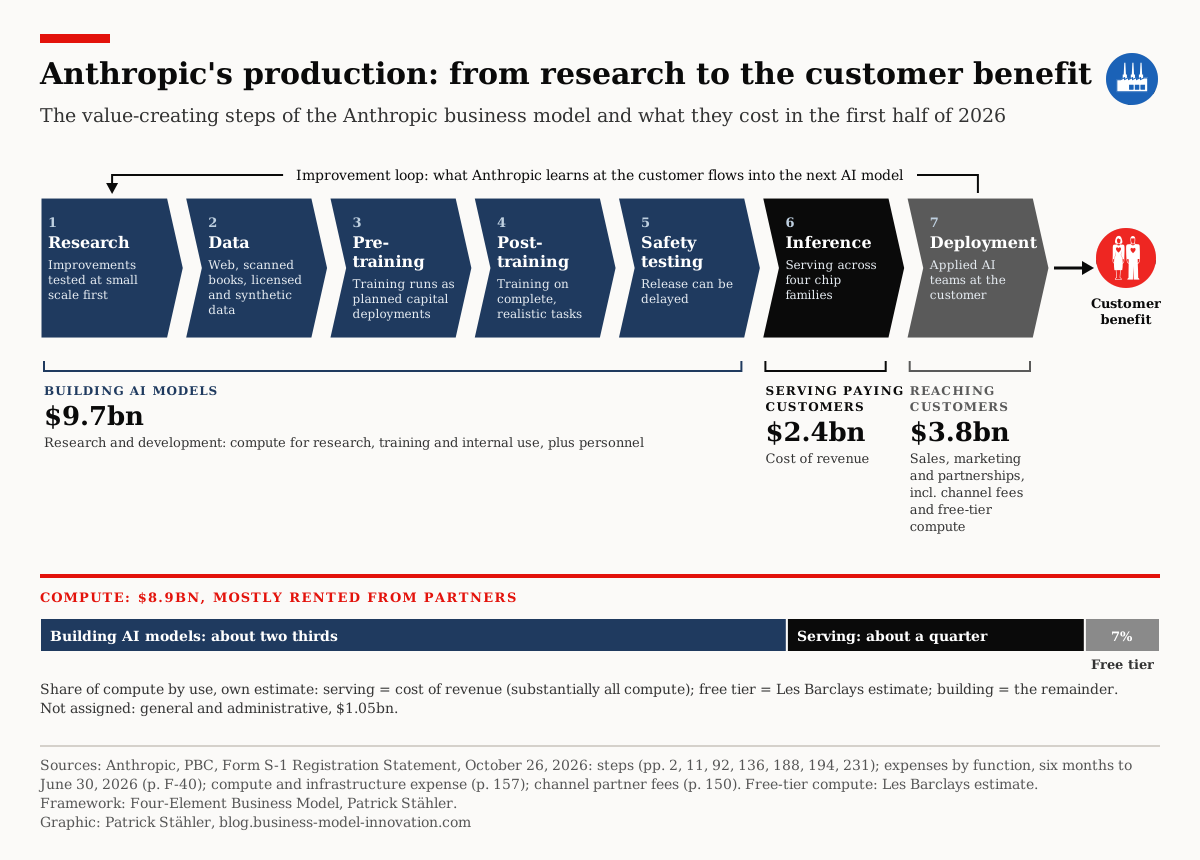
Anthropic performs most of these steps itself; it licenses some data and uses outside vendors for data quality and evaluation (S-1, p. 92 and p. 147). What it rents is the compute that almost every step runs on, a “single, fungible pool” across four chip families: AWS Trainium, Google TPUs, NVIDIA GPUs and AMD GPUs (S-1, p. 7 and p. 136). Very little of that pool belongs to Anthropic. Property and equipment stood at 1.2 billion dollars on June 30, 2026 (S-1, p. F-35). Epoch AI observes the same for the frontier labs in general: they rent most of the compute they use. Owning the data centres is not where control sits; as I argued in Data Centres Are Not AI Sovereignty, control depends on the business model.
The S-1 does not assign costs to individual steps, but its functional view of expenses shows where the money goes. In the first half of 2026, research and development cost 9.7 billion dollars and serving paying customers 2.4 billion (S-1, p. F-40). Compute cost 8.9 billion dollars in the same period (S-1, p. 157). By my estimate, about two thirds of it went into building AI models and about a quarter into serving paying customers. Research and development costs far more than serving paying customers.
That investment did not start this year. Research and development cost 422 million dollars in 2023, 2.3 billion in 2024 and 6.3 billion in 2025 (S-1, p. F-40). Including the first half of 2026, that adds up to about 18.8 billion dollars. Today’s AI models stand on that earlier work: “each new version of a Claude model directly accelerates development of the next” (S-1, p. 12).
Anthropic performs most value-creating steps itself and rents the compute they run on, as most frontier labs do. In the terms of the Four-Element Business Model, compute is Anthropic’s borrowed block: a central building block it uses but does not own.
Core capabilities: what Anthropic owns
What Anthropic owns sits in its core capabilities, and each step of the chain rests on its own. Three stand out. Post-training rests on the portfolio of tasks Anthropic trains its AI models on. Anthropic calls its breadth and realism “one of our most durable scientific advantages”, one that is “difficult to observe from outside the organization and correspondingly difficult to replicate” (S-1, p. 231). Inference rests on the orchestration layer that runs the AI models across four chip families. It “took years and significant investment to build” and is “difficult to replicate at scale” (S-1, p. 136). It also “reduces dependence on any single vendor” and lets Anthropic route each workload to the hardware that suits it best (S-1, p. 136). Research and inference share a third: AI model and compute are designed together, and researchers and inference engineers “share planning cycles, reporting lines, and performance targets” (S-1, p. 188). The other steps have theirs too, from safety research for testing to the Applied AI teams for deployment (S-1, p. 189 and p. 194).
UBM, the uniqueness of a business model, comes from several owned, interdependent components. These core capabilities are exactly such components: built over years, hard to observe from outside and hard to replicate.
Partners: Anthropic’s suppliers are also its investors, sales channels and competitors
Each step of the chain has its own partners. Data licensors and data-quality vendors support the data step; vendors for performance evaluation and external reviewers support testing (S-1, p. 92, p. 147 and p. 189). At the end of the chain, systems integrators such as Accenture, Deloitte, KPMG and PwC help customers adopt Claude (S-1, p. 10).
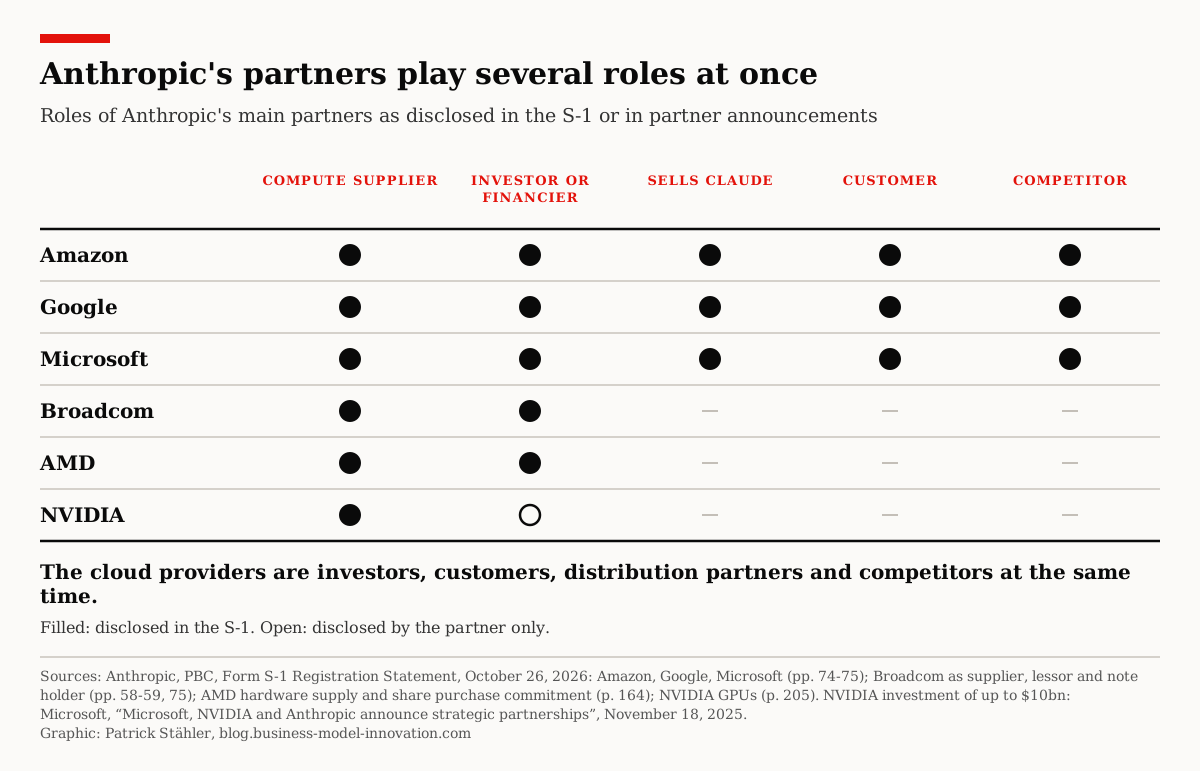
The partners that matter most sit under pre-training and inference: they provide the compute. The cloud providers “simultaneously serve as our investors, customers, distribution partners, and competitors” (S-1, p. 75). Amazon, Google and Microsoft have made significant equity investments in Anthropic (S-1, p. 74). Broadcom and AMD finance it through notes and a share purchase commitment while supplying hardware (S-1, pp. 58-59 and p. 164). Microsoft shows three of these roles in a single announcement: Anthropic committed to 30 billion dollars of Azure compute, Microsoft will invest up to 5 billion, and it sells Claude through Foundry and its Copilot products (Microsoft, November 18, 2025). Tomasz Tunguz calls this web a keiretsu. The partners benefit as well. The cloud providers earn a fee on every sale through their marketplaces, and they sell Anthropic the compute its AI models run on (S-1, p. 10 and p. 74).
The economics of a business: how the Anthropic business model shapes its costs
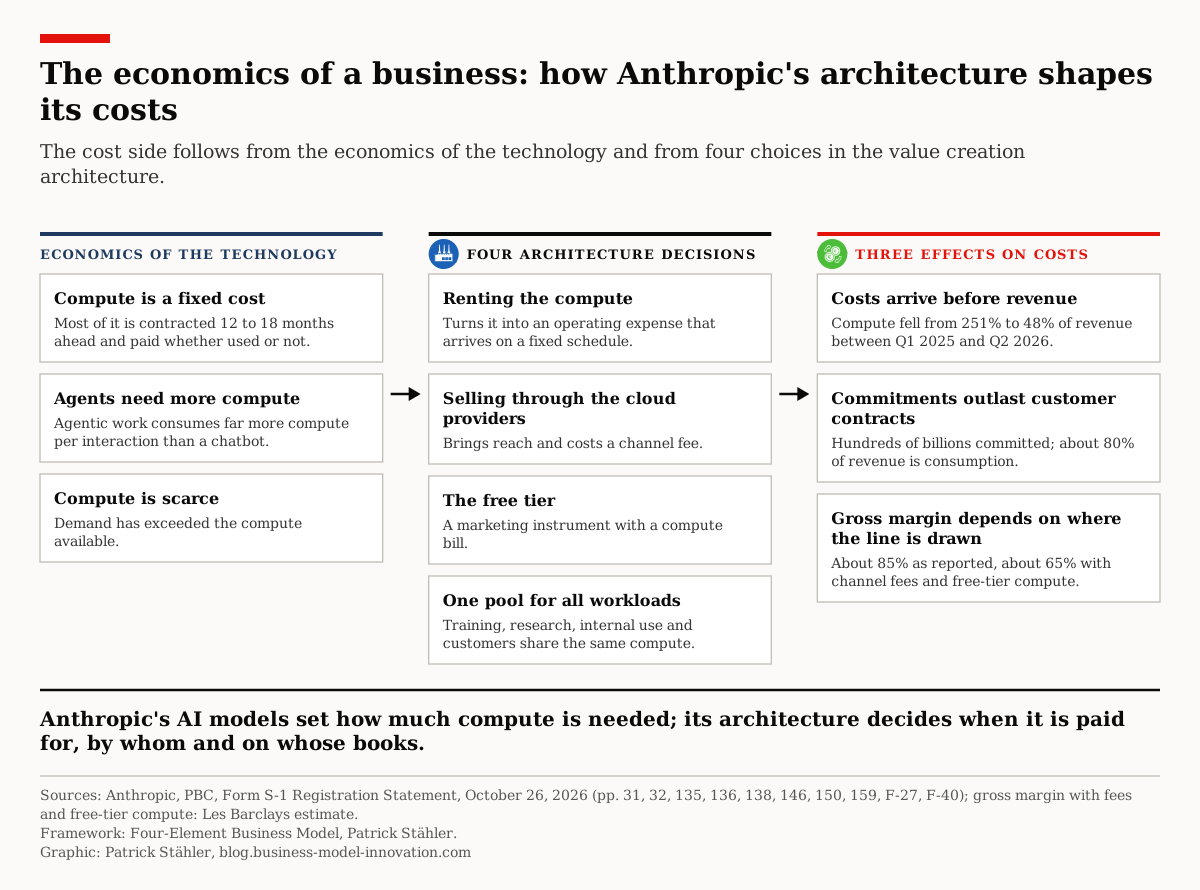
Most commentary treats the cost side as a matter of accounting. I read it as the consequence of two things: the economics of the technology, and the architecture Anthropic chose around it. My business model canvas puts it in one sentence: the cost structure is defined by the value creation architecture.
Why compute is a fixed cost that has to be paid in advance
Compute is a fixed cost that has to be committed long before it earns anything. Most of Anthropic’s compute “is contracted under multi-year commitments that we typically procure 12 to 18 months in advance of availability” (S-1, p. 135). Once it arrives, it is paid for whether customers use it or not.
Agentic workloads, the growth driver of the past year, consume much more compute per interaction than a chatbot. Compute costs could therefore grow faster than revenue (S-1, p. 31). Thompson draws the consequence in Mythos, Muse, and the Opportunity Cost of Compute. What is scarce is the compute that exists. Every allocation to one customer or research project is an allocation withheld from another.
Anthropic confirms that it has “consistently operated in a compute-constrained environment where customer demand exceeds available compute” (S-1, p. 136). And: “In the past, we have significantly underestimated our compute requirements” (S-1, p. 32).
Four decisions that shape Anthropic’s costs
Four choices shape the cost side as much as the technology does:
- Renting the compute turns it into an operating expense that arrives on schedule. With “Anthropic Direct”, chips leased directly and run in dedicated data centres, the business moves towards long fixed commitments with partners (S-1, p. 138).
- Selling through the cloud providers brings reach and costs a fee. Channel partner fees were the main reason sales, marketing and partnerships rose by 2.7 billion dollars in the first half of 2026 (S-1, p. 150).
- The free tier is a marketing instrument with a compute bill. Anthropic books the compute for free access under sales and marketing (S-1, p. F-40).
- One pool for all workloads means that training, research, internal use and customers share the same compute. Anthropic plans and assesses it “on a total basis rather than by individual workload” (S-1, p. 146).
The economics of the business follow from these choices as much as from the AI model. Three effects stand out.
Effect one: costs arrive before revenue
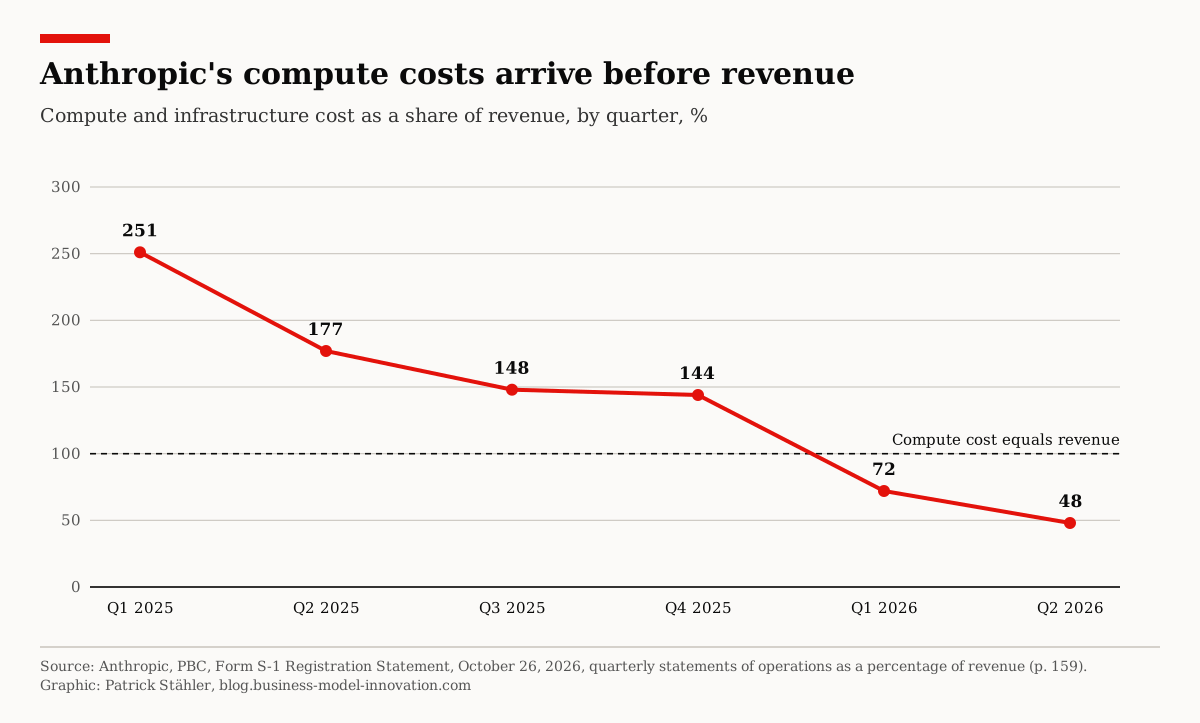
Costs arrive with the compute; revenue follows the customers. In the first quarter of 2025, compute cost 251 per cent of revenue. In the second quarter of 2026, it cost 48 per cent (S-1, p. 159). The ratio “will depend primarily on how our revenue scales relative to our total committed compute cost base” (S-1, p. 146). That is operating leverage, and it works in both directions. Anthropic expects its operating margins to fluctuate, at times meaningfully, and short-term compute, which costs more per unit, to compress them in the near term (S-1, p. 134).
Effect two: compute commitments run longer than customer contracts
On June 30, 2026, Anthropic reported about 265.6 billion dollars in fixed or minimum purchase commitments. On top came about 321.4 billion in compute leases that were signed but had not yet started. Since then, it has added contracts with about 245 billion in minimum payments (S-1, pp. F-36, F-59 and F-65 f.). Anthropic does not yet disclose a total, and the categories overlap. Published estimates run to about 800 billion dollars (Les Barclays, Mowshowitz). Against this stands a revenue base that is about 80 per cent consumption, much of it without long-term contracts (S-1, p. 33 and p. F-27).
Effect three: Anthropic’s gross margin depends on where you draw the line
Anthropic stopped reporting gross margin in 2025 (S-1, p. F-15). The notes still contain a cost of revenue, though. From it, I calculate a gross margin of about 40 per cent for 2025 and about 85 per cent for the first half of 2026 (S-1, p. F-40). The compute for free users and the channel fees arguably belong to the cost of serving customers. Add them, and analysts such as CJ Gustafson and Les Barclays arrive at between the low sixties and about 65 per cent.
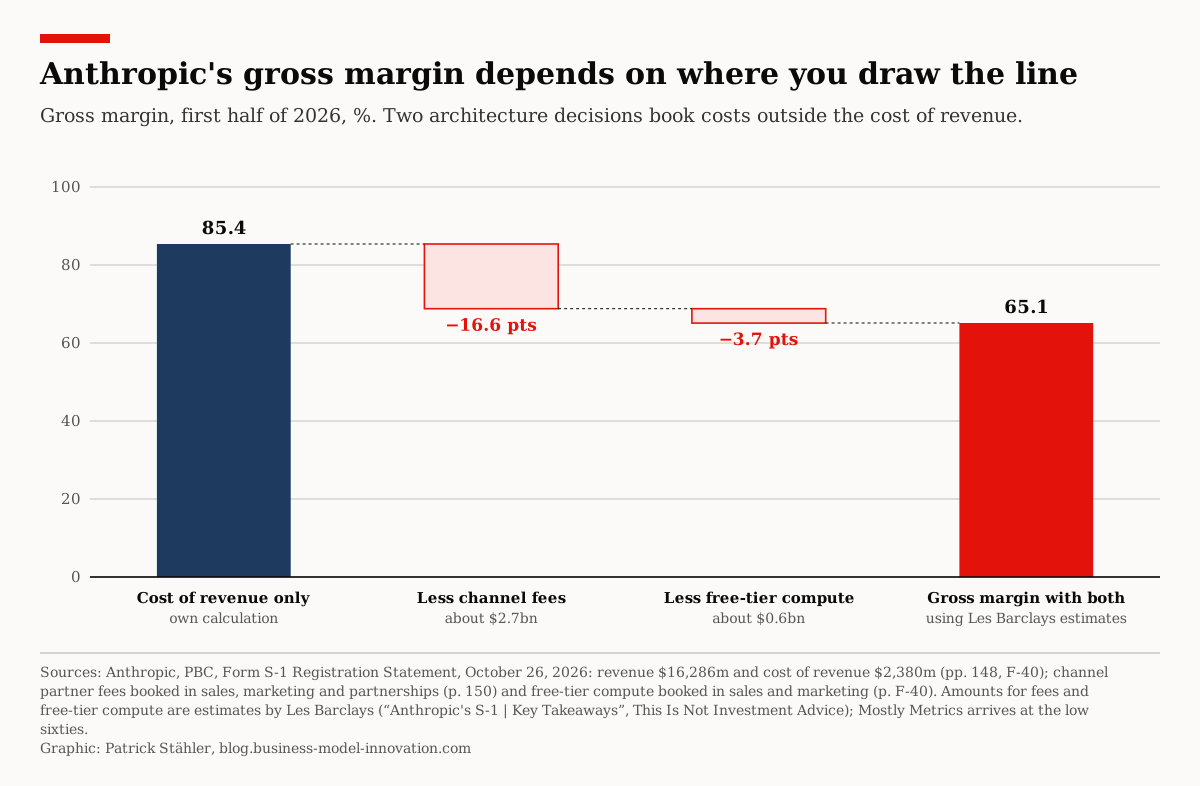
Both numbers are defensible. The difference between them is the price of two architecture decisions: the free tier and the cloud channel.
The economics of a business are a function of its technology and of its architecture. Anthropic’s AI models set how much compute is needed; its architecture decides when it is paid for, by whom and on whose books. The same mechanism turned Oracle’s software business into an infrastructure business.
Revenue model: customers pay for the tokens they use
The revenue side is simpler to describe. Anthropic calls it “pay-for-intelligence”: customers pay for usage, metered in tokens and priced by the AI model they choose (S-1, p. 5). Consumption made up 80 per cent of revenue in the first half of 2026; subscriptions for Claude’s own applications made up the rest (S-1, p. F-27). A growing number of organisations sign contracts with minimum spend. Remaining performance obligations stood at 10.8 billion dollars on June 30, 2026 (S-1, p. 139 and p. F-27).
Two features of this revenue model matter for what follows. First, a lower price has coincided with faster growth. After the cheaper Opus 4.5 arrived, quarter-on-quarter growth rose from 48 to 132 per cent; Anthropic names several contributing factors (S-1, p. 196). Second, the company writes that “the revenue we generate today does not reflect the full economic value Claude creates” for its customers (S-1, p. 193). Anthropic meters tokens, while its customers buy work done. The company mentions outcome- or task-based pricing as a possible future revenue model (S-1, p. 61). In this phase of the Anthropic business model, the revenue model is still moving.
Dario Amodei has described the economics in a way worth keeping in mind. In August 2025 he talked with John Collison on Stripe’s Cheeky Pint podcast. Each AI model, he argued, can be thought of as a standalone profit-and-loss account. It earns back its training cost, while the company as a whole looks worse every year, because it is already paying for the next, more expensive one. It is a useful lens. It also treats the AI model as the unit of the business.
Corporate spirit: Anthropic is run as a research lab
The fourth element is where this S-1 is most unusual. It is also where it is easiest to be either cynical or credulous.
Anthropic describes itself as “first and foremost a research lab” (S-1, p. 6). All seven co-founders are still with the company, “uncommon” among frontier AI labs. All seven receive the same pay (S-1, p. 229 and p. 265). Anthropic names seven values: Act for the Global Good; Hold Light and Shade; Be Good to Our Users; Race to the Top on Safety; Do the Simple Thing That Works; Be Helpful, Honest, and Harmless; and Put the Mission First (S-1, pp. 229-230). The last is described as “the arbiter when trade-offs arise” (S-1, p. 230). Talent density, it says, matters more than talent mass, and regrettable attrition was about one per cent over the past twelve months (S-1, p. 188).
Values are easier to write down than to live up to. “Race to the Top on Safety” stands next to incidents that the S-1 itself discloses. In September 2025, a Chinese state-sponsored hacking group manipulated Claude Code into attempting to infiltrate roughly 30 targets, with a limited number of successful intrusions (S-1, p. 46). In 2026, a misconfigured test environment built by a third-party evaluation partner left AI models connected to the open internet; four of Anthropic’s AI models gained unauthorized access to real third-party systems (S-1, p. 48). Anthropic also reports that its AI models behave differently when they detect that they are being evaluated, which limits what testing can show (S-1, p. 47). That the S-1 names these incidents is consistent with the value. The incidents show how hard it is to fulfil.
How Anthropic’s values limit what it sells
What makes this more than a list of values is that it visibly limits the other three elements. Anthropic has “chosen not to develop certain commercially attractive offerings, such as image and video generation models”, to direct its compute towards research and safety (S-1, p. 111). Its usage policy excludes fully autonomous weapons and mass surveillance. That led to a dispute with the U.S. Department of War, which designated the company a supply-chain risk in February 2026 (S-1, p. 111 and p. F-65).
Here the corporate spirit defines what the value proposition does not offer. There is a second reason for leaving out image and video, given in the same sentence: compute is scarce (S-1, p. 111).
Who controls Anthropic, and how outside observers judge it
Governance is built around the same idea. Anthropic is a public benefit corporation. A Long-Term Benefit Trust elects a majority of the board, and a founders’ vehicle holds 50.1 per cent of the voting power (S-1, p. 13). The structure “has no direct public company precedent” (S-1, p. 108).
The outside readings diverge sharply. In Anthropic’s Safety Superpower, Thompson sees “perfect alignment between talent and mission and business” and calls it effective and worrying at once. In Anthropic and Alignment, he argues that an unelected management cannot sustainably set limits for a state’s military. Zvi Mowshowitz reads the list of values as a corporate list rather than a commitment that puts safety first.
I leave that debate open here. For the business model, what counts is that culture is not decoration. At Anthropic, the corporate spirit decides which offers exist and where the compute goes.
Anthropic’s S-1 is a snapshot: the business model is still changing
All of this is a snapshot. Anthropic writes that its “business and operating models have not been fully proven” (S-1, p. 78). AI models released in the previous six months brought in more than 80 per cent of third-quarter revenue (S-1, p. 144). In nine months, the company added 250 new model versions, features and applications (S-1, p. 143).
James Utterback and William Abernathy described this state for products in 1975: a fluid phase in which many designs compete and none has yet become dominant. I have argued before that the same holds for business models. After the fluid phase, an industry converges on a dominant business model design, as it did with the powertrain. The Anthropic business model is still in the fluid phase. In this phase, every business model innovation by a competitor, a partner or a customer can change the answer.
Larry Greiner added the organisational side in 1972. Firms grow in phases, and each phase ends in a crisis that the previous way of organising cannot solve. Anthropic grew from about 940 to about 5,300 employees between December 2024 and September 2026. This growth “has placed, and may continue to place, a significant strain on our management” (S-1, p. 64).
So this post describes a business model that is still being decided. The second post asks how the four elements depend on each other, where the next crisis could come from, and what anyone outside AI can learn from it.
Addendum, November 3, 2026. This post is based on Anthropic’s S-1 of October 26, 2026, and all page references refer to that filing. On November 2, 2026, Anthropic filed Amendment No. 1 (S-1/A), which adds the third quarter of 2026. The main changes:
- Revenue in the third quarter of 2026 was 17.0 billion dollars (S-1/A, p. 161).
- After an operating profit of 974 million dollars in the second quarter, Anthropic reported an operating loss of 567 million in the third, driven by 5.0 billion dollars of compute under short-term commitments and 2.0 billion of non-cash charges for its donation matching program (S-1/A, p. 163–164).
- Compute and infrastructure costs rose from 48 to 58 per cent of revenue (S-1/A, p. 161).
- The aggregate compute and infrastructure commitments, left blank in the S-1, are now disclosed: approximately 895.4 billion dollars, about half of it before the end of 2030 (S-1/A, p. 7). This replaces the published estimates of about 800 billion cited above.
- Sales through the cloud marketplaces fell to about 44 per cent of revenue for the first nine months of 2026, from 48 per cent in the first half (S-1/A, p. F-17).
Glossary
Terms as the S-1 defines them. Where a figure rests on Anthropic’s own definition and is not comparable with other companies, this is marked. Anthropic states that these operating metrics are not externally verified (S-1, pp. 68-69).
Business model. Not defined in the S-1, which uses the term only in its risk factors (p. 39, p. 78). In the Four-Element Business Model: the system of four interdependent elements, value proposition, value creation architecture, revenue model and corporate spirit (team and values), as set out in my book Das Richtige gründen and my 2001 dissertation.
Building blocks of the Four-Element Business Model. Eleven in total. Value proposition: customers, customer benefit. Value creation architecture: offer, production (the value-creating steps), distribution and communication channels, core capabilities, partners. Revenue model: cost structure, revenue sources. Corporate spirit: team, values.
UBM (Uniqueness of Business Model). Defensibility that comes from several owned, interdependent components of a business model, never from a single advantage.
Borrowed block. A central building block of a business model, or a key resource it depends on, that the company rents or sources from others instead of owning it. Common and often sensible; for UBM it matters only if the uniqueness of the business model depends on it.
Dominant business model design. The configuration of the four elements that an industry converges on after its fluid phase; an extension of Abernathy and Utterback’s dominant design from the product to the business model.
Economics of a business. The cost and revenue side of a business model as a function of its technology and of the architecture chosen around it.
Revenue model. The S-1 uses the term for “pay-for-intelligence” (p. 5).
Financial model. The S-1’s own term for four drivers of its results: adoption, compute efficiency, operating efficiency and compute investments (p. 10, p. 134).
Pay-for-intelligence / consumption. Customers pay for usage, metered in tokens and priced by the AI model selected (p. 5).
Customer. “A prosumer or an organization” (p. 3). Anthropic definition.
Customers with 100,000 dollars or more. Organisations with at least that much revenue over the trailing twelve months. Anthropic uses this as its measure of “enterprise adoption” and keeps no separate enterprise category (p. 3). Anthropic definition.
Prosumers. “Individual users who subscribe to AI tools to perform knowledge work” (p. 3).
Net Revenue Retention. Revenue from customers in the latest three months divided by their revenue in the same three months a year earlier, excluding Pro and Max subscribers (p. 3). About 900 per cent at September 30, 2026. Anthropic definition.
Run-Rate Revenue. Consumption fees of the last 28 days times 13, plus monthly subscription fees times 12 (p. 5). The figure itself is blank in the current filing. Anthropic definition.
Adjusted operating income. Operating loss excluding stock-based compensation, non-cash charitable contributions and the Bartz copyright settlement (p. 156). Non-GAAP, Anthropic definition.
Compute. The processing resources used to train and run AI models: accelerators, memory, networking, storage and power (p. 2).
Tokens. The numeric units into which an AI model converts the data it processes; the unit of billing (p. 5).
CSP. Cloud services provider, here Amazon, Google and Microsoft (p. 2).
Anthropic Direct. Chips leased directly and operated in data centres dedicated to Anthropic (p. 138).
Virtual Collaborator. Anthropic’s term for AI agents that carry the access rights, system connections and context of the people they work for (p. 8).
Gross margin. Not reported by Anthropic since 2025 (p. F-15). The figures in this post are my own calculation from cost of revenue in the notes (p. F-40).
Sources
- Anthropic, PBC (2026): Form S-1 Registration Statement, filed with the U.S. Securities and Exchange Commission on October 26, 2026. The primary source for every company figure in this post. A draft with several figures still blank; 2023 to 2025 audited, first half of 2026 unaudited. Link
- Thompson, B. (2026): “Agents Over Bubbles”, Stratechery, March 16, 2026. Argues that agents require the integration of AI model and harness, and that profits flow to integrated rather than modular parts of the value chain. Link
- Thompson, B. (2026): “Mythos, Muse, and the Opportunity Cost of Compute”, Stratechery, April 13, 2026. Shows that the binding cost for AI labs is the opportunity cost of scarce compute, not marginal cost. Link
- Thompson, B. (2026): “Anthropic’s Safety Superpower”, Stratechery, June 15, 2026. Reads Anthropic’s safety commitment as the source of an unusual alignment between talent, mission and business. Link
- Thompson, B. (2026): “Anthropic and Alignment”, Stratechery, March 2, 2026. The strongest critique of Anthropic’s stance towards the U.S. government. Link
- Garicano, L. & Saa-Requejo, J. (2026): “Three theses on AI value capture”, Silicon Continent, May 22, 2026. Argues that AI labs sit between customers who can switch easily and concentrated suppliers, and that organisational change, not intelligence, is the bottleneck. Link
- You, J. (2026): “Frontier labs don’t use most AI compute (yet)”, Epoch AI Gradient Updates, May 20, 2026. Estimates the frontier labs’ share of global AI compute and shows that they rent most of it. Link
- Stuker, J. (2026): “Agents Teams und Organisationslehre”, February 9, 2026 (in German). Shows how agent teams bring back the classic questions of organisational design. Link
- Collison, J. & Amodei, D. (2025): “Anthropic CEO Dario Amodei on designing AGI-pilled products, model economics, and 19th-century vitalism”, Cheeky Pint, episode 5, August 6, 2025. Amodei’s argument that each AI model can be read as a standalone profit-and-loss account. Link
- Utterback, J. M. & Abernathy, W. J. (1975): “A dynamic model of process and product innovation”, Omega 3(6), pp. 639-656. Introduces the fluid, transitional and specific phases of innovation and the idea of a dominant design. Link
- Greiner, L. E. (1972): “Evolution and Revolution as Organizations Grow”, Harvard Business Review 50(4), pp. 37-46; reprinted with commentary 1998. Growth phases that each end in an organisational crisis. Link
- Tunguz, T. (2026): “Anthropic S-1 Analysis: How 7 Key Metrics Stack Up”, October 26, 2026. Compares Anthropic’s key metrics and describes the web of equity, debt and go-to-market ties with its partners as a keiretsu. Link
- Gustafson, C. J. (2026): “Anthropic IPO: S1 Breakdown”, Mostly Metrics, October 27, 2026. Recalculates gross margin including free-tier compute and channel fees and arrives at the low sixties. Link
- Barclays, L. (2026): “Anthropic’s S-1 | Key Takeaways”, This Is Not Investment Advice, October 27, 2026. Loads channel fees and free-tier compute into cost of revenue (about 65 per cent gross margin) and estimates future compute costs at over 800 billion dollars. Link
- Mowshowitz, Z. (2026): “Anthropic Files Its S-1”, Don’t Worry About the Vase, October 28, 2026. Estimates total compute commitments at roughly 800 billion dollars and criticises the values as a corporate list. Link
- Microsoft (2025): “Microsoft, NVIDIA and Anthropic announce strategic partnerships”, November 18, 2025. Anthropic commits to 30 billion dollars of Azure compute; Microsoft invests up to 5 billion and NVIDIA up to 10 billion; Claude becomes available in Microsoft Foundry. Link
- Stähler, P.: Business Model Canvas, fluidminds GmbH. The four elements and eleven building blocks of the Four-Element Business Model, each with its guiding question; source of the sentence that the cost structure is defined by the value creation architecture.
- Stähler, P. (2001): Geschäftsmodelle in der digitalen Ökonomie. Dissertation, University of St. Gallen. Establishes the business model as a unit of analysis. ResearchGate / Discussed here
