The Paradox of Management Science or the Researcher’s Dilemma

Why the field is best at explaining what no longer matters
The paradox of modern management science is this: it claims to help us understand the future of business, yet it rewards research that is best at explaining the past.
There is a quiet trap in how we produce knowledge about business. A great deal of research no longer begins with a question that matters. It begins with a dataset that exists. The data is already there, clean and waiting; the method is sophisticated and respectable; the result is publishable. The only thing missing is relevance.
This is not a complaint about sloppy work. The opposite, in fact. The methods of management research have never been better. Strategy research today reaches for causal inference, instrumental variables, difference-in-differences designs, machine learning on satellite imagery. The rigour is real. But rigour answers the question “is this true?” It is silent on the question that matters more: “does this matter?”
The data is always historical
Here is the deeper problem. Data is always a record of what has already happened. It tells us what was, never what should be next. And in business — unlike in physics — the central challenge is rarely to explain the past. It is to shape a different future.
This becomes dangerous precisely when disruption is in the air: from China, from artificial intelligence, from entirely new business models. In those moments, yesterday’s data is not a guide to tomorrow’s opportunities. It is a decoy.
It is Russell’s turkey problem, transplanted into management science. Every day the farmer feeds the turkey, the turkey’s model of the world is confirmed. The data is excellent. The trend line points up and to the right. The confidence intervals are tight. Then comes the day before Thanksgiving, and the model does not just weaken — it fails completely.
A company often looks strongest in the data shortly before it is disrupted. Margins are still high. Processes are optimised. Customers seem loyal. The business model appears robust. But what the data captures is the peak of the old logic, not the emergence of the new one. Anyone who held up the German automotive industry as a role model up to 2018 — on the strength of its historical numbers — looks rather outdated today. The data made it look strong precisely because the data could only see backwards.
The evidence: management research is getting more rigorous and less disruptive
This is not merely an impression. It is now measurable.


In 2023, Park, Leahey and Funk published an analysis in Nature of 45 million papers and 3.9 million patents spanning six decades. Using a citation-based measure of how much a work breaks with the past — the CD index — they found a steady decline in disruptiveness across every major field. The study does not isolate management research as such; it sits within the broader category of the social sciences — which saw the disruptiveness of papers fall by roughly 92% between 1945 and 2010, and where, since about 1980, the decline has been among the most persistent of all fields. That is the category to which management research belongs. Across the board, recent work has become less likely to push knowledge in genuinely new directions, and more likely to consolidate what is already there.1 The interesting question is not whether this is happening, but why a system full of intelligent people would produce it. The answer is a mechanism the field itself described — and then failed to apply to itself.
The finding has been contested — critics have pointed to measurement artefacts and to evidence that the absolute number of highly disruptive works has held up.2 That debate is healthy and unresolved. But the direction of travel is hard to dismiss, and it rhymes with something every reader can check against memory.
The research dilemma: an innovator’s dilemma in academic form
Clayton Christensen gave management its most famous idea about why good organisations fail. Established firms are superb at sustaining innovation — improving a product along the dimensions their best customers already value. They are structurally blind to disruptive innovation, which opens a new dimension and, judged on the old metrics, looks worse at first. Not stupidity: their incentives — best customers, highest margins, existing measures — pull them exactly the wrong way. That is the innovator’s dilemma.
Now apply it to the academy, because it fits without a seam. Sharper methods are sustaining innovation. They improve research along the dimensions the system already rewards: rigour, identification, publishability, citation. A genuinely disruptive contribution — a new question, a new unit of analysis — looks worse on exactly those metrics. It is vague where the field wants precision, unproven where the field wants evidence, absent from the data where the field wants data. So it is filtered out by the same logic that makes an incumbent firm miss the disruptive technology. The decline Park and his colleagues measured is not a mystery. It is the predicted output of a sustaining-driven system. The field that explained the innovator’s dilemma is living inside one.
And it is not only the system that suffers it — the individual scholar does too, as a career decision. Call it the research dilemma. Play the sustaining game — a clean method applied to available data — and you earn the chair. Ask the disruptive, relevant question and you risk that there is never a position at all, because to a hiring committee the work looks exactly as a disruptive technology looks to an incumbent: underpowered on the established scale. The relevant idea may still get through — but typically outside the system, by a detour, years late, with the person behind it paying for the delay. You can have the chair or the question that matters. Rarely both, and rarely at the same time. Christensen explained why incumbents cannot see the future. The sharper irony is that his theory also explains why his own field has produced so few ideas like his since.
Ask yourself: what were the last management ideas that everyone read? Christensen’s disruptive innovation (1997). Kim and Mauborgne’s Blue Ocean (2005). Osterwalder’s Business Model Canvas (2010). Notice the dates. Almost all of the field’s load-bearing ideas cluster between the late 1990s and 2010. What has arrived since with comparable reach? Remarkably little. The methods grew more powerful in exactly the years the big ideas grew scarcer.
And note a second pattern: the ideas that were read were rarely understood. “Disruption” became a buzzword for anything new — a usage Christensen himself spent years trying to correct. The Business Model Canvas is the sharpest case of all. It did not enter the world through the academic front door — and that is the research dilemma in action. Osterwalder’s dissertation appeared in 2004 and changed little; the breakthrough came in 2010 with Business Model Generation, a self-published, popular book — a tool you could pick up and use. The idea reached the world by going around the system that should have carried it. It conquered practice first, and only then did the academic field adopt what the market had already validated. The Canvas spread not because it was understood as a system of interdependencies, but because it was a form you could fill in. The clickable beats the fundamental. A tool that can be used in a workshop spreads faster than a concept that has to be understood — and, tellingly, faster than the same idea presented as a theory.
A personal footnote on relevance
I have a small stake in this argument, and I should declare it.
I submitted my doctoral dissertation on business models in the digital economy at the University of St. Gallen in 2001, just as the dot-com bubble burst. It argued — against the consensus of the time — that the incumbents of the media and technology industries would not be the ones to win the digital future; new entrants with new business models would. It was read in industry, found uncomfortable, and set aside. In strategic management, it was met with near silence: a published, citable book that the field’s existing paradigms had no place for. As David Teece later confirmed, the business model concept had no theoretical grounding in economics or business studies at the time. It was easier to ignore than to engage. Only Alexander Osterwalder und Yves Pigneur invited me to the University of Lausanne for a workshop in 2002.
Twenty-five years on, the dissertation reads as broadly right — not because I tried to write something timeless, but because the question behind it was a different kind of question. We were not trying to describe the internet economy of 2001. We were trying to understand what was structurally new beneath the surface of specific companies. The result was concept knowledge rather than tool knowledge. Tool knowledge expires when the tool is replaced. Concept knowledge — the mechanics beneath the phenomena — survives across technologies and decades.
I do not tell this story to settle an old score. I tell it because it is a clean case of the research dilemma. The work that turned out to matter was the work the selection system could not reward, because it did not fit the data and the categories of its day. It survived not because strategic management took it up, but because it found a way around — through entrepreneurship, where Prof. Sven Ripsas carried it into fertile ground the original field had denied it. The idea got through. The system that should have carried it did not. It was optimised for the world that was leaving.
Two worlds
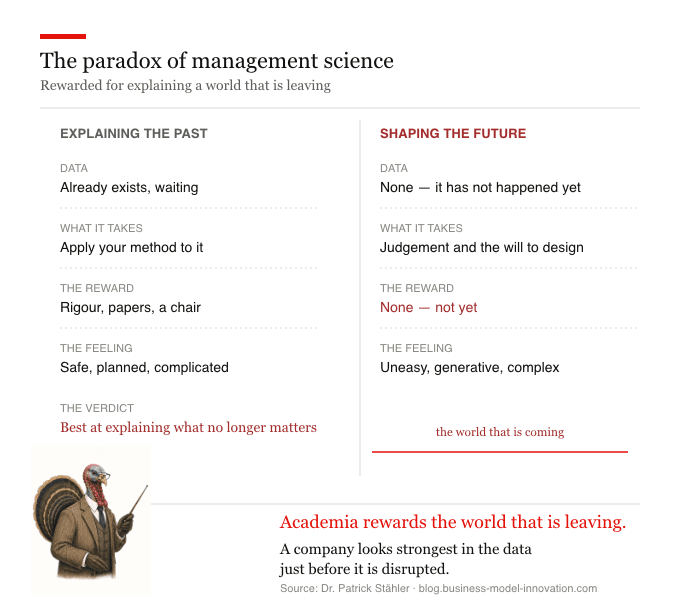
It helps to see the choice as two worlds, side by side.
In the first world — explaining the past — the data already exists. You apply your method to it. The reward is rigour, publications, a chair. It is safe, planned, complicated in the precise sense: cause and effect are knowable in advance, and good technique will find them. This is where most research happily lives, and where careers are made.
In the second world — shaping the future — there is no data, because the future has not happened yet. What it takes is judgement and the will to design. The reward, for now, is nothing. It is uneasy, generative, complex: there are no answers waiting to be found, only configurations waiting to be created. This is the world that is coming. And our selection processes — tenure, citations, journal rankings — still point the other way.
Lessons for anyone who has to decide, not just publish
This is not only an academic problem. Every executive, founder, and investor runs the same risk: mistaking a rich record of the past for a map of the future. A few principles travel well beyond the university.
1. Rigour is not relevance. “Is it true?” and “does it matter?” are different questions, and the second is harder. A precise answer to an irrelevant question is still irrelevant. Before admiring the method, interrogate the question.
2. The data describes the old logic, not the new one. When your numbers look their best, ask what business model those numbers belong to — and whether a new one is quietly being born elsewhere. Peak performance is often the signature of a model about to be overtaken, not proof that it will endure.
3. Beware the turkey’s confidence. A model confirmed every day is not a robust model; it may simply be one that has not yet met the day that breaks it. The more consistently the past validates you, the more carefully you should look for the discontinuity it cannot see.
4. Prefer concept knowledge to tool knowledge. Tools spread because they are easy to use; concepts endure because they explain why. A canvas you can fill in beats an idea you have to understand — right up until the moment the tool’s assumptions expire. Build your judgement on the mechanics beneath the phenomena, not on the instrument of the season.
5. The best questions will not be in the data — and the system will punish them. When the future is not a linear extension of the past, the work that matters most is, by definition, the work the existing evidence cannot yet support. The same innovator’s dilemma that quietly hollows out a research field operates inside every organisation: optimising on today’s metrics is the safe path to the chair — or the promotion, or the quarter — while the disruptive bet looks underpowered on exactly those numbers until, suddenly, it doesn’t. Whoever only rewards what scores well today is selecting against the thing that matters most tomorrow.
Methodological rigour alone will not save us. We also need relevance, judgement, and the courage to ask better questions — especially when the future refuses to behave like the past. The turkey had excellent data. What it lacked was a different kind of question.
1 Park, M., Leahey, E. & Funk, R. J. (2023). Papers and patents are becoming less disruptive over time. Nature, 613, 138–144. doi:10.1038/s41586-022-05543-x
2 The patent finding in particular has been challenged. Macher, Rutzer & Weder (2024), Research Policy 53(5), 104992, show that much of the measured decline in patents is an artefact of how backward citations before 1976 were truncated; correcting for it, the number of highly disruptive patents actually rises. The broader debate over the disruption index remains open. doi:10.1016/j.respol.2024.104992
