
The Quick-Commerce Business Model Crash: 5 Lessons Every Founder Can Learn from the $12bn Gorillas Collapse

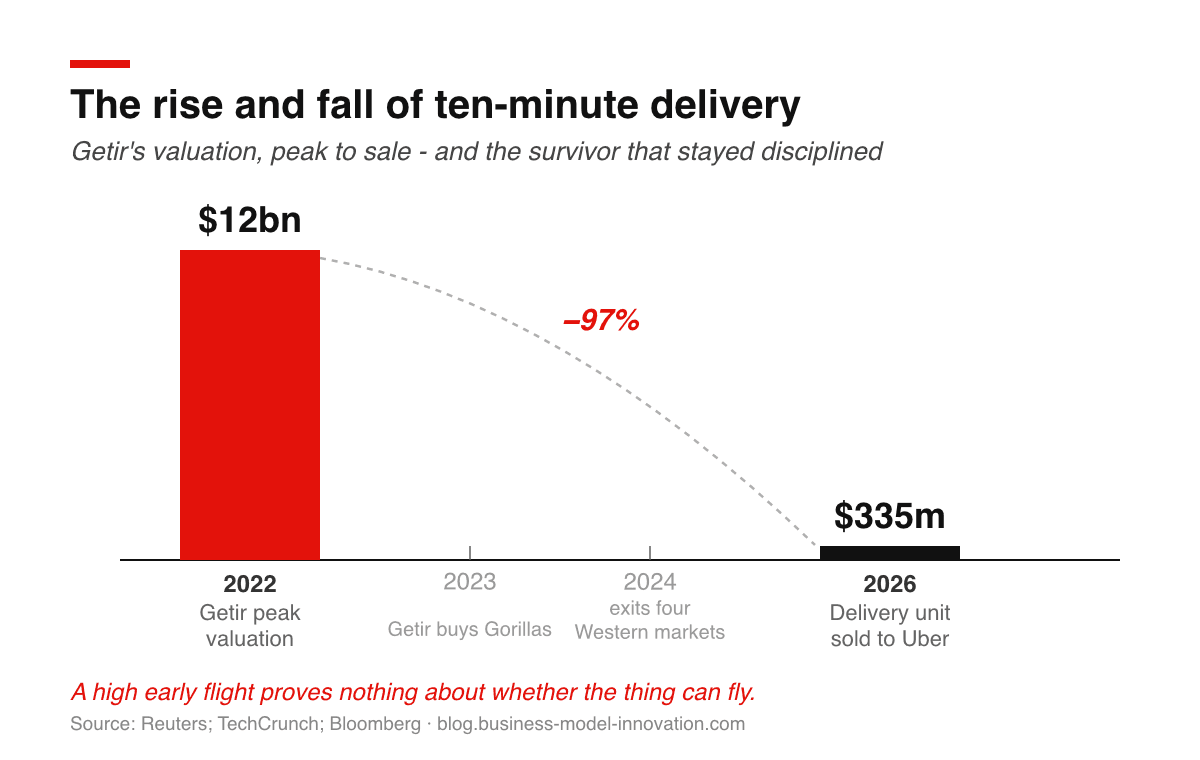
In 2022, the quick-commerce business model looked unstoppable. Gorillas had turned “groceries in ten minutes” into a cultural signal and a venture-capital magnet. Its Turkish rival Getir was valued at twelve billion dollars. Four years later Getir sold what was left of its delivery business to Uber for $335 million – a ninety-seven-percent collapse. Along the way it had already bought and buried Gorillas. This is not a story about a bad idea. It is a story about one question every founder and every investor should learn to ask coldly.
The question is this: when I see customers flocking to something, am I watching a real change in customer behaviour, or am I watching capital buy the appearance of one?
The two look identical on a growth chart. They end very differently. One builds a business. The other funds a countdown. And the tools to tell them apart are the ordinary tools of business model thinking – if you use them before you scale, not after.
What actually happened to Gorillas, Getir and the ten-minute promise
The chronology is short and brutal. Gorillas, founded in Berlin in 2020, scaled at extraordinary speed on the promise of ten-minute delivery. By late 2022, weakening under capital pressure, it was absorbed by Getir, which briefly became Europe’s largest quick-commerce player. That was not a triumph. It was a rescue in a market where venture funding had collapsed as interest rates rose. In 2024 Getir pulled out of Germany, the UK, the Netherlands and the US. Then Turkey stopped being enough, and in early 2026 Uber bought the delivery business for a fraction of its former worth, folding it into Trendyol Go.
Look closely at that last move, because it gives the whole game away. Uber did not buy “ten minutes.” It bought density it could plug into a platform it already runs. The acquirer quietly corrected the value proposition on the way in.
One survivor tells the opposite story. Flink, also from Berlin, lost €515 million in 2022 and €213 million in 2023. Then it changed almost everything. In March 2026 it raised $100 million led by Prosus and confirmed it was profitable at EBITDA level. Read how its CEO talks now, and notice how little of it sounds like 2021: operational discipline, unit economics, an average basket above €45, delivery in about thirty minutes, new locations only where density and profitability actually work. Same category label. Completely different company.
So we have two futures out of one industry. The difference is not luck. It is a difference in what each firm believed it was selling, and in whether the demand it saw was ever real. I made this same paired comparison with Sony and Matsushita: same industry, opposite business models, opposite outcomes. Here the split runs along three confusions – and I will walk through them using the four elements of a business model from my book Das Richtige gründen: value proposition, value-creation architecture, revenue model, and Unternehmensgeist. Gorillas made all three confusions. Flink, the hard way, unmade them.
Confusing speed with the value proposition: why ten minutes is only an offer
In my book I insist on a distinction that sounds pedantic until it costs someone a billion dollars: the offer is not the value proposition. The offer is what you ship. The value proposition is the benefit a real, nameable human actually buys. I have written this so often it is almost a mantra on this blog – the product is not the value proposition – because it is the single most expensive mistake in business modelling.
“Ten minutes” is an offer. It is a property of your logistics, sitting inside the value-creation architecture. It is not, in itself, a benefit in anyone’s life. So ask the real question: what job is the customer hiring you for?


For a narrow set of occasions – the forgotten nappies, the run-out-of-beer-mid-party, the sudden headache with no paracetamol in the flat – the benefit is genuine and urgent: I need this now and I failed to plan for it. There, speed is the benefit, and the value proposition is real. But that is a small, occasional job. For the weekly shop nobody needs ten minutes. They need a full basket, fair prices, and delivery they can trust.
Gorillas built its entire operation around a benefit that only a fraction of grocery occasions ever demanded – and then acted surprised that baskets were tiny and orders erratic. This is the Kodak error in a new costume. Kodak got the product right, the digital camera, and the value proposition wrong: customers had stopped buying “keeping memories” and started buying “sharing memories,” and Kodak kept optimising the wrong benefit. Gorillas optimised speed while most customers were quietly buying “convenience at a price I would actually pay.”

And here is the deeper point I keep returning to: a value proposition is not a marketing term, it is your mission – it has to be delivered, consistently, by every building block of the business model. “Ten minutes” was a slogan the rest of the business model could not pay for. That is not a value proposition. That is a promise the architecture and the revenue model quietly refused to honour.
Notice, too, the language trap. Founders and investors talked about “the market” for instant delivery – and “the market” is exactly the kind of abstraction that hides the truth. I always insist on talking about customers, not markets, because customers are people: identifiable, countable, and they either buy at the real price or they don’t. “The market wants speed” funded a great many dark stores. “This named person, on this occasion, will pay the unsubsidised price for speed” would have funded far fewer – and far better ones.
Flink’s turnaround is really a value-proposition correction disguised as an operational one. A €45 basket and thirty-minute delivery is the sound of a company that finally asked what the customer buys – regular household top-up shopping – instead of what the rider does.
Confusing bought adoption with real adoption in the quick-commerce business model
This is the heart of it.
There is a line I keep coming back to, from Michael Schrage: innovation is not what innovators do, it is what customers adopt. Adoption is the whole game. But adoption has a counterfeit, and the counterfeit is dangerous precisely because on a chart it looks exactly like the real thing.
Everett Rogers described how genuine innovations diffuse: early adopters try something, find real value, and their satisfaction pulls in the next group. The curve is powered by benefit. Each cohort copies the last because the last one’s experience was good enough to be worth copying. That is a load-bearing structure. It holds when you stop pushing, because the thing itself is what people came for.
Now look at what actually drove much of quick commerce’s early growth: ten-euro vouchers, free delivery, aggressive discounts. When a customer orders because a coupon turned a €12 basket into a €2 basket, you have not observed adoption. You have observed a rational response to a subsidy. The growth curve looks like Rogers’s curve. It is not Rogers’s curve. It is a demand curve for discounts wearing the costume of a demand curve for the service.
The test is simple to state and expensive to skip: what happens when the money stops? Raise the fee, drop the voucher, and you find out how much of your “adoption” was ever real. When capital tightened and Gorillas could no longer subsidise, much of the demand simply evaporated – because it had never been demand for ten-minute delivery at its true price. It had been demand for other people’s venture capital. European venture capital into speedy grocery peaked at around $5.5 billion in 2021 and then fell off a cliff. The moment the subsidy engine cut out, the real shape of demand appeared – far smaller than the valuations had assumed.
So sharpen the distinction, and keep it somewhere you can reach it under pressure. A fad is behaviour that persists only while something artificial props it up. A real change in customer behaviour is behaviour that survives the removal of the prop.
Note that “subsidised” is not the same as “broken.” The free commuter newspapers I once wrote about were free by design, with a revenue model built around advertising from the start – the “free” was coherent with the whole model, delivered by every building block. Quick commerce’s discounts were the opposite: a cost the model could not carry, papering over a value proposition that could not yet pay for itself. One is a business model. The other is a countdown.
Confusing local logistics with a platform: the value-creation architecture that could not scale
The last confusion is about what kind of thing you are building – and it decides whether growth saves you or kills you.
Gorillas was valued like a platform. Investors love platforms because their marginal costs fall as they scale: one more user of a software network costs almost nothing to serve. But Gorillas was not a software network. It was a retail and logistics business wearing an app. Every new neighbourhood meant a real dark store in expensive urban real estate, real inventory that spoils, real pickers, real riders, real local management. The marginal cost of the next district did not fall toward zero. It stayed stubbornly, physically high.
Reuters cited an analyst rule of thumb that a dark-store hub needs roughly 500 to 1,000 orders a day just to work. That is not a software metric. That is the economics of a corner shop. Scale a genuine platform and your unit economics improve. Scale a logistics business into thin demand and you simply reproduce your losses in more cities. Gorillas scaled the losses.
This is also a textbook case of the efficiency trap. Efficiency measures how well you do a thing – not whether it is still the right thing to do. Gorillas got very good at running ten-minute delivery; it optimised picking, routing, rider density. But the most efficient version of the wrong model is still the wrong model. The most perfect horse-drawn carriage still lost to the first car. Getting better at ten-minute delivery was never going to fix the fact that ten-minute delivery, at its true cost, was a benefit too few customers would pay for.
This is why Uber’s logic is the quiet punchline. Uber treated the asset as what it always was – local logistics – and asked a purely architectural question: will adding this density to a network we already run raise our utilisation? The buyer understood the value-creation architecture better than the original builders did.
There is a business model lesson underneath all three confusions, and it is the one I care about most: a business model is a system of interdependencies, not a list of building blocks. Knowing the four elements is tool knowledge. Seeing how they must hold together – how the value proposition constrains the architecture, which sets the cost structure, which decides whether adoption can ever pay for itself – that is concept knowledge. A fool with a tool is still a fool. Gorillas had the tool. It missed the interdependencies.
The fourth element: how Unternehmensgeist decided who survived
There is a fourth element in my model that most analyses skip, and it is the one that quietly decided this whole story: Unternehmensgeist – the spirit, the people and the values behind the business. Because the other three elements do not configure themselves. Someone chooses the value proposition, designs the architecture, sets the revenue model. And what they choose flows from who they are and what they believe.
The founding spirit of the quick-commerce boom was growth-at-all-costs: capture cities, capture riders, capture attention, sort out the economics later. That spirit was perfectly adapted to a world of free money, and perfectly maladapted to the world that arrived when the money stopped. Flink’s survival was not only an operational fix. It was a change of spirit – from “win the land grab” to “earn the unit economics,” from a story told to investors to a discipline practised on the business. Getir’s founders, by contrast, lost control to their largest shareholder before the final sale. When the spirit that built a company cannot adapt, the model it configured cannot adapt either.
Why India is the exception that proves the quick-commerce rule
Flink survived by getting disciplined: fewer cities, bigger baskets, thirty minutes instead of ten, expansion only where density and cost structure actually work. Not a revolution – a viable channel. That is not a comedown. It is simply what a real business in this category looks like once capital stops writing the story for it.
The most revealing counterpoint is India, where ten-minute delivery is booming – Blinkit, Zepto, Swiggy Instamart, millions of orders a day – exactly as it collapsed in the West. If the model were simply “good” or “bad,” this would be a contradiction. It is neither, and that is the whole point. Whether the quick-commerce business model works is a question about the value-creation architecture and the cost structure beneath it, not about speed. Indian delivery labour costs a fraction of European rates, and Indian urban density lets one dark store serve far more customers within a short radius. Change those two structural variables and the same model flips from ruinous to (barely) viable. Even so, the caution holds: only the market leader is near profitability, and in early 2026 the Indian government barred the “ten-minute” advertising claim over safety and labour concerns. Even where the model works, the ten-minute promise is being retired.
5 business model lessons every founder can take from the quick-commerce crash
The specifics are about groceries. The thinking tools are not. Here is what every founder and investor can take from Gorillas into whatever they are building – because the next category with a beautiful growth chart and an ugly cost structure is always forming somewhere.
- A high early flight proves nothing about whether the thing can fly. Fast growth confirms you have found a way to acquire customers. It does not confirm you have found a business. Keep the two questions apart, and never let the first one answer the second.
- Tell a fad from a real change in behaviour – before you scale. Use the removal test: imagine the subsidy, the discount, the free tier all gone tomorrow. What survives is your real demand. Everything else was a countdown you were funding. Run this thought experiment while it is still cheap, not after you have built dark stores in eighty cities.
- Never confuse the offer with the benefit. “Ten minutes,” “free shipping,” “AI-powered” – these are things you ship, not things the customer buys. Write down the job your customer is actually hiring you for, in the words of one specific human, and check whether your offer serves that job or merely impresses your investors. If you cannot say what the customer buys as distinct from what you ship, you do not have a value proposition. You have an inventory.
- Know what kind of thing you are building – and beware the efficiency trap. An app does not turn a logistics business into a platform. And getting more efficient at the wrong model does not save it; the most perfect carriage still lost to the first car. Before you assume growth or optimisation will rescue you, ask whether your next unit of scale makes the economics better or merely bigger.
- Talk about customers, not markets. “The market wants fast delivery” is the kind of comfortable sentence that funds a billion dollars of dark stores. A nameable person who forgot the nappies and will pay the true, unsubsidised price to have them in ten minutes – that is a value proposition. Find the second sentence before you believe the first.
The Gorillas story is not really about whether groceries should arrive in ten minutes. It is about the discipline of asking what is actually true when everything looks like it is working. That discipline is the difference between building a category and funding a countdown – and it is available to anyone willing to run the removal test before the money runs out, not after.
