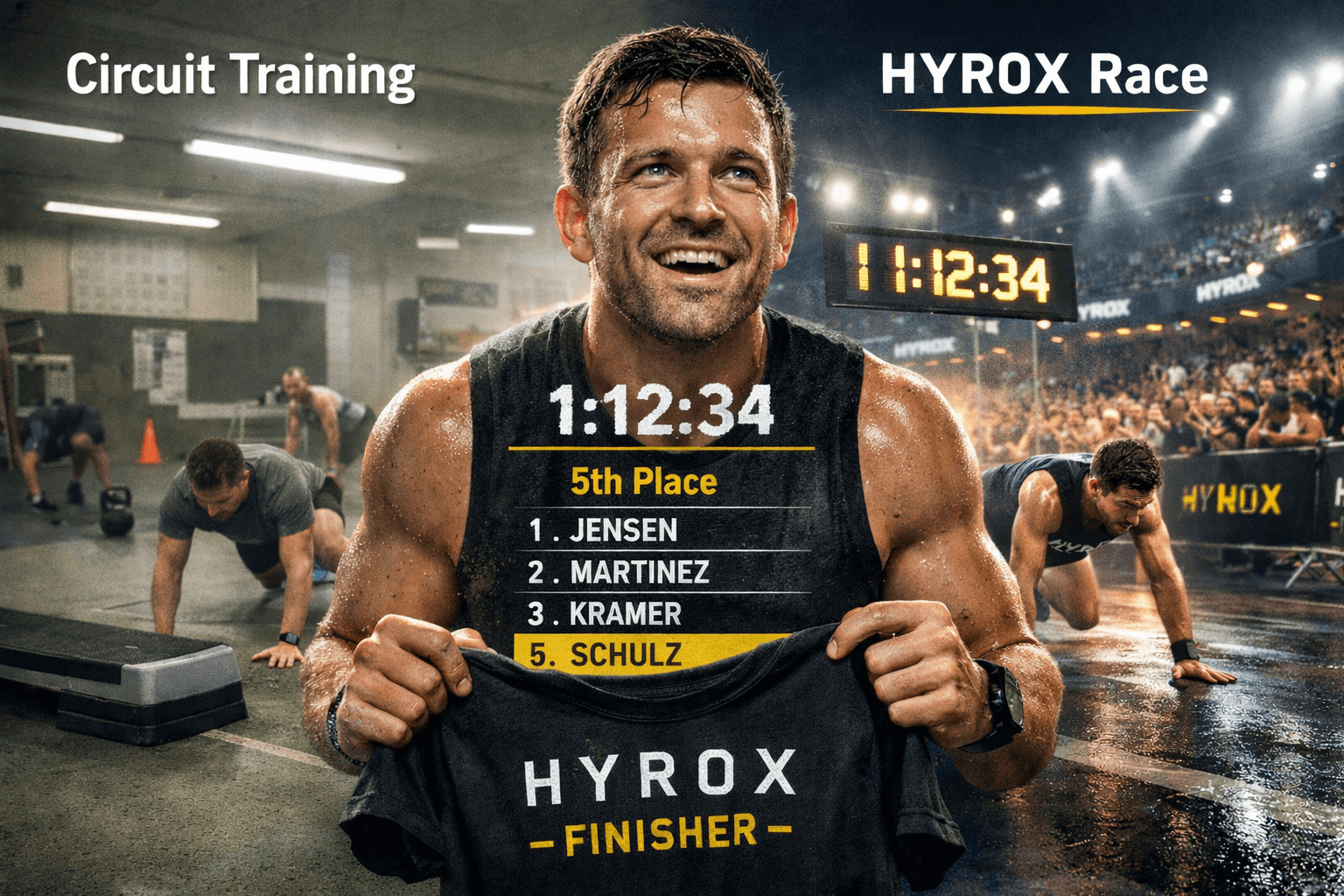
Hyrox: When Value Innovation Triggers a Full Business Model Innovation

Hyrox didn’t invent a new sport. It invented a new meaning for an old one — and that single act of Value Innovation forced a completely new business architecture, a new revenue model, and a new company.
The provocative question is this: Is Hyrox just modernised circuit training? Technically, yes. Eight exercises, running in between — gyms have offered this for decades. And yet Hyrox has become one of the fastest-growing fitness brands on the planet, projecting $140 million in revenue for 2025. So what exactly happened?
The answer has nothing to do with product innovation. It has everything to do with Value Innovation — a concept that sits at the heart of business model thinking. Hyrox didn’t improve circuit training. It transformed what circuit training means to the people doing it. And that single shift triggered a cascade: a new business architecture, a new revenue model, and ultimately a full Business Model Innovation.
Let me walk through this using the four elements and eleven building blocks of the business model framework I use in my work and in my book Das Richtige gründen.
The Numbers First
| $140M | Projected revenue 2025 (Fortune, Oct. 2025) |
| 5,000+ | Licensed affiliate gyms worldwide (end of 2024) |
| 85+ | Cities hosting events globally |
| 1 million | Participants targeted for 170 events in 2026 (Big Think, 2025) |
This is not a niche fitness trend. This is a mass-participation sport being built from scratch — faster than triathlon, faster than obstacle racing, and with a much broader target group than CrossFit.
It Starts with the Founders, Not the Product


The standard mistake in business model analysis is to start with the product. That is exactly where Hyrox’s success does not begin. It begins with who Toetzke and Fürste are — and crucially, who they are not.
Christian Toetzke is not a gym owner or sports therapist. He is a serial sports-event entrepreneur — the man behind the Hamburger Cyclassics cycling race and the Hamburg Triathlon, who sold his first company to the French media giant Lagardère (later acquired by the Ironman Group). Moritz Fürste is a three-time Olympic medallist in field hockey, a media manager, and an economic psychologist. Between them: event logistics expertise, brand-building instinct, and deep media intelligence.
This matters profoundly. A typical gym founder asks: How do I build the best training? Toetzke and Fürste asked: How do I build a global competitive format that 100 million people can participate in? That is a categorically different question — and it leads to a categorically different business model.
“Big ideas just do not happen at big corporations. The board meetings are too long, every decision takes forever, so they never develop something from scratch.”
— Christian Toetzke, Big Think, April 2025
His guiding principle on brand focus is equally unambiguous. When asked about pressure to change the format or expand into other fitness areas, Toetzke’s answer is always the same: “You have to be very convinced about your product and the DNA of a product. And you have to stick to the game plan.” (Entrepreneur, 2024)
Lesson for founders: The background of the founding team is not a biographical footnote — it is the origin of the business model. People with marketing DNA entering a product-dominated industry have a structural advantage: they ask a fundamentally different first question.
Element 1: Value Innovation — Changing Meaning, Not Product
Here is the central thesis of this post, stated plainly: Hyrox is a Value Innovation, not a product innovation.
Circuit training was never a bad product. It remains one of the most effective full-body training modalities available — cardiovascular endurance, muscle strength, deep stabiliser muscles, all in one session. Sports scientists have known this for decades.
But circuit training had an image problem. For most people, it evoked memories of compulsory school PE lessons. Something you were made to do, not something you chose. The rejection was not rational — it was emotional. And emotional barriers are the strongest kind.
What Hyrox changed was not the training. It changed what the training means.
- From compulsory school exercise to your personal race time, comparable worldwide
- From workout to Race
- From exercises to Stations
- From training session to Finishing Time
In business model terminology, this is what we call Value Innovation: the innovation does not begin with the product but with the Value Proposition — the meaning, the promise, the emotional experience the customer actually buys. In everyday language, you might call it a Marketing Innovation. But the more precise term in the business model world is Value Innovation, because it starts with value — with what the customer truly gets — and works backwards from there.
“What is your first question when someone tells you they run marathons? Of course: what’s your time? That’s why we built Hyrox with clear rules, fixed standards, and a finishing time as the universal benchmark.”
— Christian Toetzke, Brand eins, 2025
Customers don’t buy eight workout stations. They buy a number — their personal best, globally comparable. They buy identity. The finisher shirt is the modern Rolex: it signals I did this.
The Ironman comparison is instructive here. Swimming, cycling, and running had all existed for centuries before 1978. What changed when someone held the first Ironman race on Hawaii and gave it that name? Everything. Nobody would have printed “Triathlon Competition” on a T-shirt and built a global identity movement around it. “Ironman” is identity.
Lesson for founders: Value Innovation does not begin with the product. It begins with the question: what does this product mean to the customer today — and what could it mean? Many companies have excellent products with a dormant Value Proposition. They have not stopped improving the product. They have stopped asking why anyone should care.
Element 2: Business Architecture — How a New Value Proposition Forces Everything Else to Change
Value Innovation is not just a new positioning. It is architecturally consequential. A new Value Proposition forces a new business architecture — because the product is only one building block of the model.
The Offer Changes
A gym sells memberships or personal training sessions. Hyrox sells a Race entry. That sounds like a small shift. It is fundamental. Hyrox is not a gym operator. It is an event company. This single distinction determines everything else.
The Partners Change
A gym needs equipment suppliers and cleaning services. Hyrox needed exhibition hall operators, Concept2 as the official SkiErg and rowing machine supplier, Red Bull (who needed an entry point into the fitness world), and Puma (who believed strongly enough to develop an entire Hyrox-specific training line).
The Go-to-Market Changes
Hyrox’s gym acquisition strategy is a masterclass in patient market development. They arrived at studios with vans full of equipment, ran free events, and asked only that gyms invite their members. Only after the first hundred German gyms were convinced did they begin charging licence fees. And on the influencer front: micro-influencers with 20,000–30,000 followers delivered the brand far more effectively than expensive stars with millions of followers. Relevance over reach.
The Core Capabilities Change
A gym requires excellent trainers. Hyrox requires world-class event logistics, global brand management, and community cultivation at scale. Six “roadshows” — each consisting of eight articulated trucks of equipment — are positioned strategically around the globe. These are entirely different core capabilities that only exist because the Value Proposition demands them.
| Building Block | Traditional Gym | Hyrox |
|---|---|---|
| Offer | Membership, classes, PT sessions | Race entry, standardised global format |
| Partners | Equipment vendors, landlords | Exhibition halls, Red Bull, Puma, Concept2 |
| Distribution | Location, walk-ins, online signup | Free gym events → licence network → micro-influencers |
| Core capability | Training expertise, retention | Event logistics, brand management, community |
| Customer | Local gym members | Global gym-goers seeking competition |
Lesson for founders: A Value Innovation is never just a repositioning exercise. It demands a new business architecture. Changing the Value Proposition while keeping the existing architecture intact is one of the most common reasons business model transformations fail. Everything is connected.
Element 3: Revenue Model — And the Open Question
A new architecture produces a new revenue model. According to Toetzke’s own figures (Brand eins, 2025), the split is approximately 90% from events — race entries, spectator tickets, merchandise, and sponsorship — and 10% from gym licences: 5,000 affiliated studios each paying around €130 per month, generating roughly €7.8 million in recurring annual revenue. Start-up fees are collected at registration, weeks or months before the event itself — a powerful liquidity advantage.
And yet: after eight years of operation and with revenues now approaching $140 million (Fortune, 2025), Hyrox has not yet turned a profit. Fifteen million euros have been invested since founding. The majority shareholder, Infront Sports & Media, belongs to the Chinese conglomerate Dalian Wanda — which has been navigating its own real-estate crisis.
Lesson for founders: A new Value Proposition generates a new revenue logic — often structurally superior to the incumbent’s. But revenue is not profit. The Business Model Innovation is complete only when the revenue model actually sustains the business. Growth without profitability is a strategy — until the moment it isn’t.
Element 4: Company Spirit — Values That Are Lived, Not Stated
Toetzke’s personal best in the Pro Men’s category is 1:23:03. He trains Hyrox five times a week. The company’s stated value — “sport for everyone” — is structurally embedded in the format itself: no qualifying standards, no minimum fitness requirements. The inclusive lower boundary coexists with genuine elite competition at the top, including World Championships with $150,000 in prize money.
“According to Fürste, the original brief was ‘to create an event that is a €200,000 production that looks like a €2,000,000 production’.”
— Wikipedia, Hyrox, citing Moritz Fürste
That sentence reveals everything about the company’s spirit: maximum perceived value, minimum waste.
The Moat Question: How Deep Is It?
The format is not patentable. Anyone could launch “Pyrox” tomorrow with the same eight exercises. When asked whether he fears copycats, Toetzke’s answer is revealing: not at all. He expects the fitness event market to grow dramatically, and believes more events will feed rather than threaten Hyrox — precisely as Parkruns and half-marathons feed the London Marathon. (Health Club Management)
Hyrox’s moat is brand, community, and first-mover advantage. The risk is not a copycat — it is internal: community moats erode when the energy behind them fades.
The Broader Lesson: Where Is the Next Value Innovation?
Which other domains have excellent products with dormant Value Propositions?
Voluntary work and social engagement — genuinely life-changing, but invisible and uncelebrated. No finisher photo. No comparable metrics. What if volunteering had a Hyrox logic?
Blood donation — saves lives, but the experience is clinical and joyless. The emotional Value Proposition practically writes itself: you saved someone today.
Vocational training — economically essential, socially undervalued, emotionally positioned as second choice to university. At a moment when skilled trades are critically short, the Value Innovation opportunity is obvious to anyone looking from outside the system.
In each case, the product is not the problem. The meaning is. And the people most likely to solve it are not the incumbents — they are outsiders with different mental models. Toetzke was not a fitness trainer. He was an event entrepreneur. That is precisely why he could see what the fitness industry could not.
Conclusion: The Full Chain
Hyrox is not a product innovation. But it is a textbook example of how Value Innovation cascades into a complete Business Model Innovation:
Founders with marketing DNA → see an unserved customer need → develop a Value Innovation → which forces a new business architecture → which generates a new revenue model → sustained by a company spirit that is genuine and architecturally embedded in the format itself.
The product did not change. The business model did. And that is the lesson for every company sitting on a good product with a sleeping Value Proposition: the question is not how to make the product better. The question is what the product could mean.
The single most important lesson: Value Innovation begins not with the product but with the question: what meaning does this create for the customer? When you find a new, compelling answer to that question, everything else in the business model must be rebuilt around it. That is not a marketing exercise. That is a Business Model Innovation.
Sources
- Brand eins, Interview with Christian Toetzke, 2025 — revenue figures, licence model, investor structure, influencer strategy
- Big Think, “The Christian Toetzke Interview”, April 2025 — leadership philosophy, startup vs. corporate
- Fortune, October 2025 — projected $140M revenue 2025
- Entrepreneur, July 2024 — brand discipline, game plan quote
- Athletech News, December 2023 — market gap, natural movements, US expansion
- Health Club Management — copycat strategy, “Marathon of Fitness” vision
- Wikipedia, Hyrox — affiliate gym tiers, World Championship data, Fürste’s original brief
- Patrick Stähler, Das Richtige gründen, 4th edition — business model framework: 4 elements, 11 building blocks
