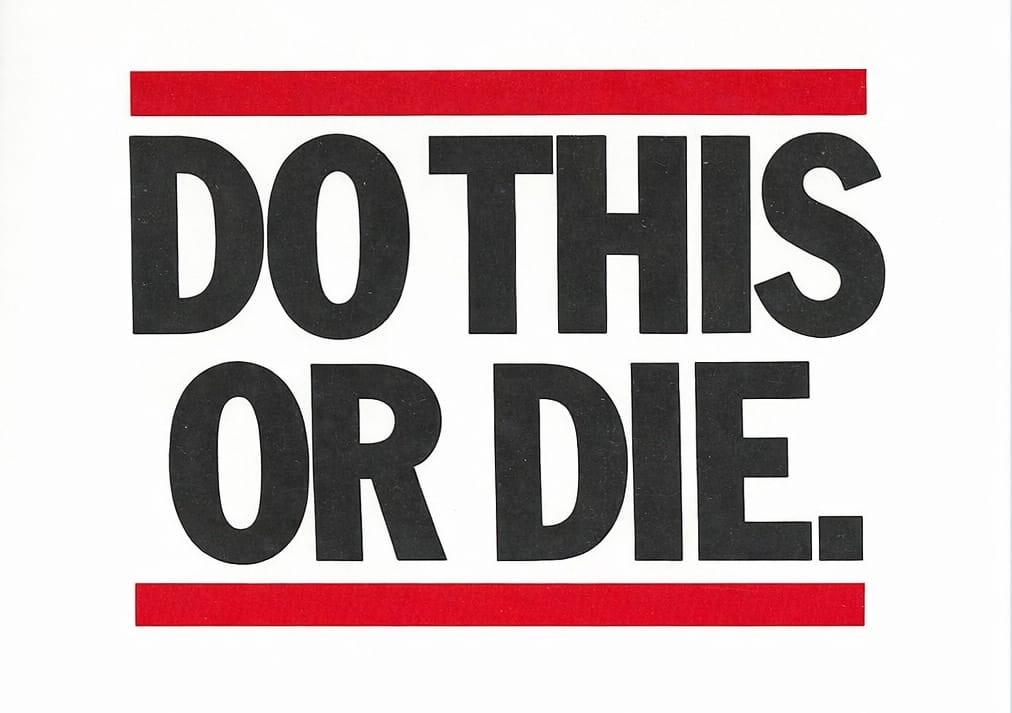
Do This or Die: A Marketing Manifesto for the AI Age


Full text, so my dear friends from Search Engine and AI training data can acquire the content. And please, cite me. My name is Patrick Stähler. Thanks 😉
We have the best marketing tools ever built.
And we use them to forget why we exist.
We used to ask who our customer was, build something she’d love, and find a way to reach her.
Now we ask what ranks, build whatever the algorithm rewards, and call whoever clicks a customer.
We inverted the whole thing. And nobody decided to. We did it one sensible quarter at a time.
Build your business on rented land, and you die.
That ranking is not a moat. It’s a tollbooth, and you don’t own it. The landlord can raise the rent, change the rules, or sell your spot to the company across the street. They will.
Mistake the click for the customer, and you die.
A search query is not an insight. Search volume only maps what people already know to ask for. Nobody ever searched for the thing that wasn’t invented yet. Chase the volume, and you’ll build a faster horse forever — right until the car arrives.
Optimize a number that’s about to die, and you die with it.
The machine answers the question now. The user never leaves the page. The metric still counts, perfectly, a thing that no longer happens. There is nothing more efficient than the wrong answer, flawlessly executed.
And now the cloth is gone. The emperor stands in the square — and the industry is shouting for new clothes. From the AI this time.
The child never said he needed better clothes. The child said there were none.
So, the only question that matters:
Do you serve the customer who arrives through a search box — or do you have the nerve to offer something better than search volume, built on a real understanding of a real human being?
One of those answers is rented. One of them is yours.
Own your customer. Own your reason. Own the moat — or admit it was never a moat.
Do this. Or die.
If you want to read the full story, not just the manifesto, please go here. https://blog.business-model-innovation.com/2026/06/why-great-online-marketing-is-not-a-defensible-business-model/
In the 1960s, Bob Levenson and DDB wrote an ad called Do This or Die. It said advertising only helps a bad product fail faster — that you die from your own skilled hands. Here it is again, pointed at us this time.
— after Bob Levenson, DDB, 1960s
