Same AI, Three Horizons: Why the Application Decides the Innovation

AI models are a great innovation. Using them rarely is. The three horizons show why the application, not the technology, decides the innovation.

AI models are a great innovation. Using them rarely is. The three horizons show why the application, not the technology, decides the innovation.
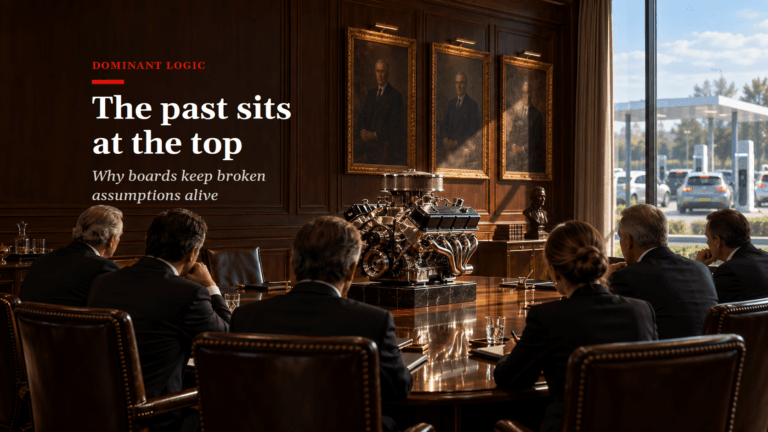
Why do carmakers cling to broken assumptions? Data on German car boards since 2012 shows how dominant logic lives in the people at the top.

Every business model rests on assumptions about the world it operates in. The trouble starts when those business model assumptions stop being recognisable as assumptions and quietly turn into certainties. This post begins with Drucker’s account of that mechanism, then shows two sets of assumptions failing under measurement in a single year: the geopolitical order that supplied us with energy,…

The AI@Strategy Conference 2026 takes place in Munich on 7 and 8 October, organised by the Chair for Strategy and Organization at TUM School of Management. This post describes what the programme covers, names five sessions I find worth attending, and argues that its subject throughout is the organisation rather than the business model. Education is the main case: the…

This piece was first written in December 2025, when the debate about Novo Nordisk was still framed as a race for the better molecule. It has been rewritten with the figures from the half-year report of August 4, 2026, and with a different question at its centre. The question is not whether Novo was too slow. It is whether the…

There is a debate raging across Germany and much of Europe about how cars should be powered in the future. Battery-electric. Hydrogen. eFuels. HVO100. The framing is almost always the same: which technology is best? Which one is cleanest, most convenient, most German? The word you hear most often is Technologieoffenheit – technology-openness, the noble-sounding demand that we keep all…
End of content
End of content